Governance of climate-related risks and opportunities
Our governance around climate-related risks and opportunities involves a combination of policies, procedures and oversight mechanisms that enable us to address the potential impacts of climate change on our business.
Board oversight
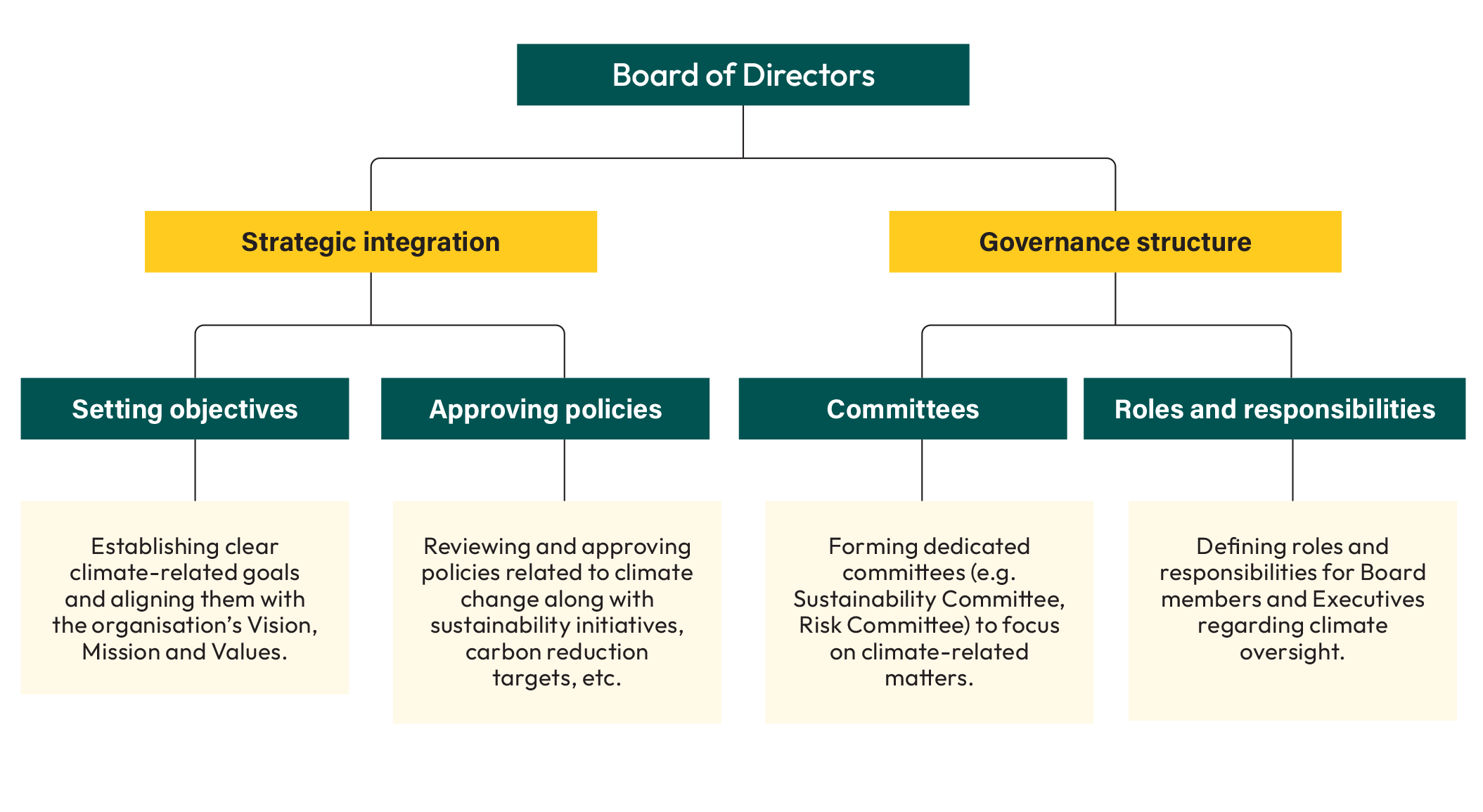
Our governance framework for climate-related risks and opportunities involves rigorous oversight by the Board of Directors. Through semi-annual and quarterly meetings respectively, the Risk Management Committee and the CSR and Sustainability Board Committee, assess and oversee these risks and opportunities, ensuring that climate considerations are integrated into our strategic direction.
Management's role
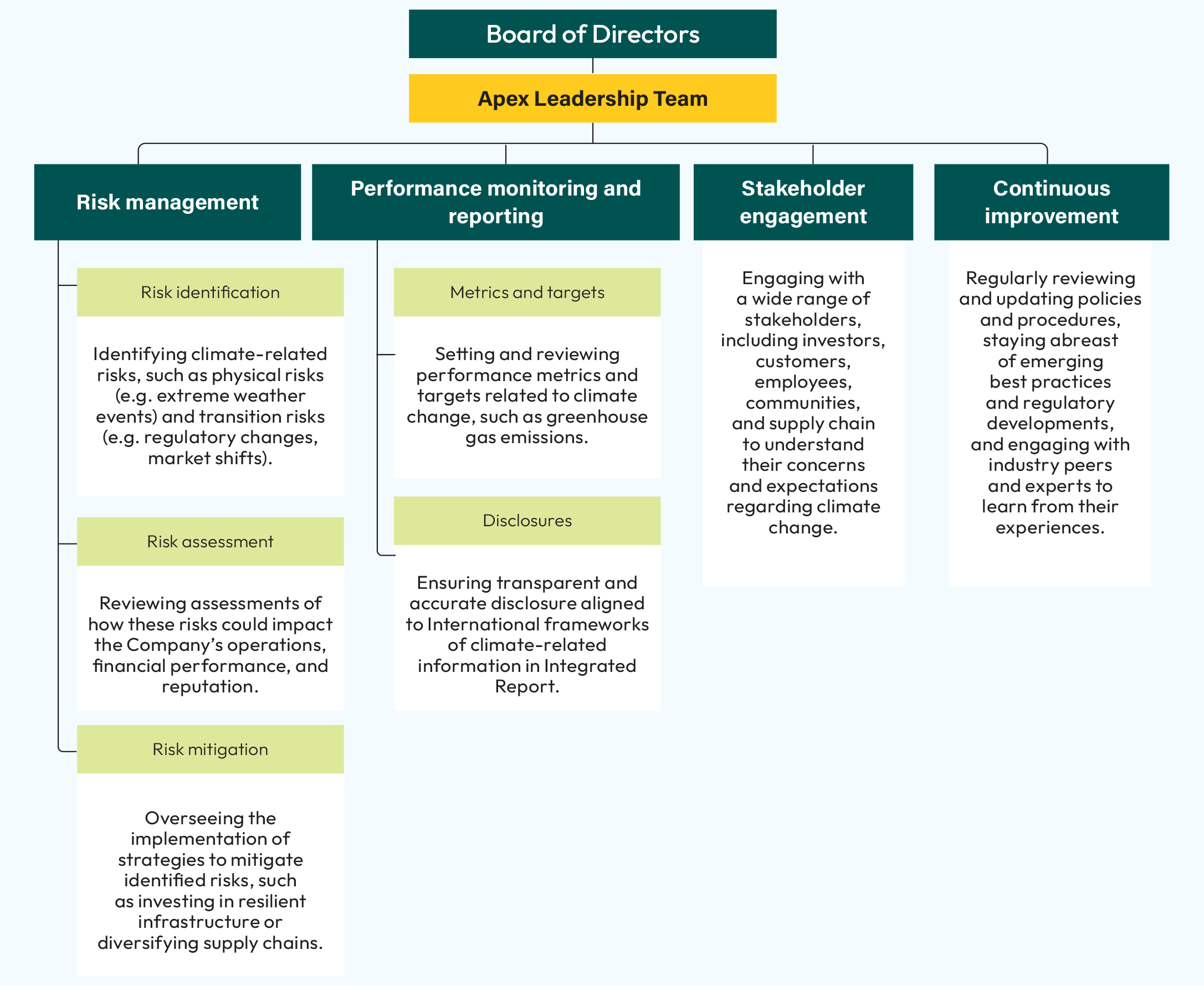
Our management team plays a crucial role in identifying, assessing, and managing climate-related risks and opportunities. It is responsible for implementing strategies that align with our commitment to sustainability and climate resilience. This involves integrating climate considerations into operational practices, financial planning, and long-term strategic goals.
Strategy and business planning
At Tata Power, we are committed to energy efficiency, renewable technology, and enabling electric mobility aligning with our strategy to transition to 100% Clean and Green generation by 2045. Our strategy includes robust risk assessments and mitigation plans to address climaterelated risks and seize opportunities, promoting sustainable business practices. Our comprehensive approach ensures that all upstream and downstream activities in the value chain contribute to decarbonisation.
In the Business Planning process, due consideration is taken to identify targets as per material issues for enterprise value creation and this is tracked through a comprehensive review mechanism along with inclusion into Key Responsibility Areas of the Executives.
Our march towards 100% Clean and Green energy by 2045
- Emphasising energy efficiency and renewable technology advancements
- Reducing reliance on thermal power operations and focusing investments on renewable and pumped hydro projects
- Developing smart grid solutions and energy management services within the Transmission and Distribution cluster
- Achieving Net Zero for emissions and managing water and waste judiciously
Identified climate-related opportunities and risks for short, medium and long-term
We identified various climate-related risks and opportunities across short-, medium-, and long-term horizons.
Energy efficiency initiatives
Implementing energy-saving measures


Energy source
Providing Round-the-Clock Green Energy

Products / services
Launching green solutions like rooftop solar and EV charging
Markets – green financing
Accessing green bonds and sustainable finance instruments for growth

Resilience
Developing resilient infrastructure and operations
Acute
Cyclones, hurricanes, or floods
Scenario Sensitivity: Tata Power has carried out Scenario Sensitivity for water risks for Pessimistic, Business-As-Usual and Optimistic Scenarios.
Chronic
Heatwaves
Scenario Sensitivity: Tata Power has carried out Scenario Sensitivity for water risks for Pessimistic, Business-As-Usual and Optimistic Scenarios.
Policy and legal
Regulatory changes and increased GHG emissions pricing
Technology
Advancements in solar PV technology and battery energy storage systems
Market
Shifts in customer behaviour and energy costs
Reputation
Changes in consumer preferences, stigmatisation of conventional generation, and stakeholder concerns
Negative Financial impact Positive financial impact Renewables and New-age Energy
Solutions Transmission and
Distribution
Thermal and HydroRisk management
Climate-related risks are integrated into our overall risk management framework through the Enterprise Risk Management process, influencing strategy formulation at the Annual Strategy Workshop.
The Board-level Risk Management Committee at Tata Power evaluates climate-related risks annually, with quarterly reviews by cluster-wise committees. Risk owners and champions develop mitigation strategies aligned with our renewable energy goals and Science-Based Targets initiative (SBTi) commitments.
This process includes creating risk maps and presenting them to the CEO & MD and the Risk Management Committee.
The Board-level Risk Management Committee conducts thorough reviews of high-impact risks, developing and overseeing mitigation strategies. An internal audit department ensures the sustained effectiveness of these strategies. Sub-committees focus on sustainability initiatives, aiming to achieve carbon neutrality, enhance sustainability efforts and promote circularity in business practices.
Climate-related risks are integrated into our overall risk management framework through the Enterprise Risk Management process. The Risk Management team ensures regular reviews with the risk owners from the business and functional aspect and is reported to Board-level Risk Management Committee.
Metrics for assessing risks and opportunities
| Metric | Unit | FY26 | FY25 |
|---|---|---|---|
| Greenhouse Gas (GHG) emissions | |||
| Scope 1, 2, and 3 emissions | Million tCO₂e | 26.067Scope 1 emissions 2.587Scope 2 emissions 26.569Scope 3 emissions | 41.352Scope 1 emissions 3.202Scope 2 emissions 26.677Scope 3 emissions |
| Carbon intensity | |||
| Total Scope 1 and Scope 2 emission intensity per rupee of turnover | Metric tonnes of CO₂ equivalent/Revenue (₹) | 0.0000450 | 0.0000691 |
| Total Scope 1 and Scope 2 emission intensity in terms of physical output (Total Scope 1 and Scope 2 GHG emissions / Total Power Generation Units (kWh))* | Metric tonnes of CO₂ equivalent/kWh | 0.0007902 | 0.0008410** |
| Energy usage | |||
| Total energy consumption | GJ | 36,12,22,833 | 51,22,59,954 |
| Energy intensity | |||
| Energy intensity per rupee of turnover | Total energy consumed (GJ) / Revenue from operations (₹) | 0.000567 | 0.000794 |
| Energy intensity in terms of physical output | Total energy consumed (GJ) / Total Power Generation Units (kWh)* | 0.0071565 | 0.0076196** |
| Water usage and management | |||
| Total water withdrawal | KI | 3,70,45,63,485 | 6,62,57,27,051** |
| Waste management | |||
| Total waste generated | Metric tonnes | 55,85,113 | 62,32,871 |
| *Generation units exclude units from international assets as
submitted for exclusions
during BRSR to maintain conformity with regulatory disclosure. **FY25 numbers have been restated. |
|||
Targets and progress
- To raise our Clean and Green portfolio percentage to 70% by 2030
- Net Zero by 2045
- We are at 47% Clean and Green operational capacity
- We will achieve 66% of Clean and Green capacity post completion of projects-in-pipeline
- We are SBTi validated
Nature-related disclosures
Nature-related disclosures
We are aligned to the Taskforce on Nature-related Financial Disclosures (TNFD), a global framework guiding organisations to identify, assess, manage, and disclose nature-related risks and opportunities. This initiative supports the transition towards nature-positive outcomes by integrating environmental considerations into business and financial decision-making processes. By adopting the TNFD framework, we ensure that our operations align with global biodiversity goals and contribute to a sustainable future. The alignment to the TNFD underscores our dedication to environmental stewardship and sustainable development. The findings from this approach will help integrate nature considerations into our broader sustainability strategy, supporting our commitments to water, waste and emissions.
Biodiversity and nature conservation at Tata Power
At Tata Power, biodiversity is recognised as a critical enabler for long-term sustainable economic growth and environmental responsibility. As part of our commitment to the Tata Code of Conduct, we ensure that in the production and sale of our products and services, we strive for environmental sustainability and comply with all applicable laws and regulations. As part of Tata Group’s Project Aalingana, Tata Power is actively working towards achieving No Net Loss of Biodiversity by 2030 and integrating nature considerations into financial planning, operations, and corporate strategy.
Our Biodiversity Policy is guided by the mitigation hierarchy laid upon the framework: Avoid, Minimise, Remediate and Offset, ensuring that biodiversity and nature-based risks are addressed across the entire project lifecycle—from land acquisition and design to construction, operation, and end-of-life.
Governance framework for biodiversity
We have a strong governance structure to oversee and implement biodiversity initiatives across our operations. The CSR and Sustainability Board Committee provides strategic guidance by meeting quarterly, while the Apex Leadership Team reviews to ensure effective delivery. Corporate Sustainability function is the standard keeper and ensures alignment with business priorities as well as Global and National frameworks. At each location, the initiatives are executed by SPOCs and through business partners.
Biodiversity Commitment is fully integrated into the organisation's decision-making process and is supported by all of its operational and functional units. It is monitored through governance tools like Business Reviews (Integrated Review Management System, IRMS), Annual Business Plan (ABP) integration, Risk Mapping (Enterprise Risk Management, ERM) and KRA linkage in Performance Management Systems (PMS).
Global and national commitments — UN SDGs
United Nations Sustainable Development Goals (UN SDGs)
Our commitment is aligned with all UN SDGs relevant to Biodiversity with focus on:
- SDG 13 — To take immediate actions to combat climate change and its impacts by promoting nature-based solutions, afforestation and other mitigation strategies
- SDG 14 — To protect and promote sustainable use of the oceans, seas and marine resources for sustainable development
- SDG 15 — To protect, restore and promote sustainable use of terrestrial ecosystems, sustainably manage forests, combat desertification, and halt and reverse land degradation and halt biodiversity loss
- SDG 17 — To strengthen and revitalise partnership for sustainable biodiversity conservation by mobilising resources, sharing knowledge and encouraging multi-stakeholder collaborations
Task Force on Nature-related Financial Disclosures (TNFD)
We took the leadership w.r.t Biodiversity Commitment in the Energy Utility sector during TNFD launch in India, by participating in a pilot assessment for the Task Force for Nature-related Financial Disclosures in 2023 to identify ecosystem service interdependencies and create a risk plan.
National Biodiversity Strategy and Action Plan (NBSAP) 2024
India has developed National Biodiversity Strategy and Action Plan (NBSAP), which outlines the implementation of the Convention on Biological Diversity's Global Biodiversity Framework at the country level. The objectives of NBSAP are aligned with the GBF.
Tata Power is committed to the NBSAP 2024 through implementation of Biodiversity Action Plans across locations.
CII India Business & Biodiversity Initiative (IBBI) 2.0
We were a key stakeholder in the development of CII IBBI 2.0 framework. This framework represents the alignment of business operations with the Global Biodiversity Framework (GBF) and endeavours to operate in harmony with nature through a series of actionable steps.
Our approach to human rights and engagement with indigenous people, local communities, and stakeholders in nature-related risks and opportunities
We recognise that respecting human rights is fundamental to achieving sustainable and inclusive growth. Our human rights policy and stakeholder engagement processes are closely aligned with our environmental and social goals, particularly as they relate to nature-related dependencies, impacts, risks, and opportunities.
Human rights policy and governance
We have institutionalised a robust human rights commitment framework, rooted in globally recognised standards such as the UN Global Compact (UNGC) and the International Labour Organisation (ILO) conventions.
We maintain a zero-tolerance policy on child labour, forced labour, workplace harassment, and discrimination across all operations and value chains.
Key features of Tata Power’s policy and governance framework
- Adherence to the UN Guiding Principles Reporting Framework, which guides due diligence, assessments, and corrective actions
- Strategic guidance by CSR & Sustainability Board Committee and the Apex Leadership Team, ensuring alignment of human rights with environmental and social risk management
Stakeholder engagement and inclusion of indigenous people and local communities
We identify stakeholders—including Indigenous Peoples (IPs), Local Communities (LCs), and affected individuals—through business divisions and functional teams. These groups are mapped based on the actual and perceived impacts of Tata Power’s activities on their environment, livelihoods, and cultural resources.
Strategy
We have leveraged globally recognised tools, such as the WWF Biodiversity Risk Filter (BRF) and ENCORE, to gain a comprehensive understanding of how its operations intersect with nature. These advanced tools enable us to assess our environmental dependencies and impacts, while also identifying potential risks and opportunities related to biodiversity.
The WWF Biodiversity Risk Filter (BRF) is an interactive, science-based tool developed by the World Wide Fund for Nature (WWF) to help businesses identify, assess, and respond to biodiversity-related risks across their operations and supply chains. It integrates global environmental datasets with business activity information to evaluate mainly physical and reputational risks linked to biodiversity and ecosystem services.
For this assessment, physical and reputational risks were evaluated across our key operating assets using the BRF tool.
- Physical risks include site-level exposure to ecosystem degradation and environmental hazards (e.g., water scarcity, soil and air degradation, extreme weather events)
- Reputational risks reflect potential stakeholder concerns or public scrutiny linked to biodiversity-sensitive areas, such as proximity to conservation zones or the presence of endangered species
We carried out assessment of risks (Physical and Reputational) along with impacts and dependencies for 11 operational assets across Thermal, Hydro, Solar and Wind sites which is representative of our operating portfolio.
Physical risks
Physical risks refer to the tangible and measurable environmental changes and hazards that arise from ecological degradation and climate change. These risks can directly impact business operations, supply chains, infrastructure, and community well-being.
Total physical risk
| Asset | Total physical risk |
|---|---|
| Thermal | Medium → High |
| Hydro | Medium → High |
| Solar | Low → Medium |
| Wind | Medium |
Provisional services
| Asset | Water availability | Forest productivity and distance to markets |
|---|---|---|
| Thermal | High | Medium → High |
| Hydro | High | - |
| Solar | Medium | - |
| Wind | High | - |
""-""represents data “No Dependency or impact” as per output of WWF Biodiversity Risk Filter tool.
Regulating and supporting services – enabling
| Asset | Water condition | Air condition |
|---|---|---|
| Thermal | Low | High |
| Hydro | Medium | Medium → High |
| Solar | Low | High |
| Wind | Low | High |
Regulating services – mitigating
| Asset | Landslides | Wildfire hazard | Extreme heat | Tropical cyclones |
|---|---|---|---|---|
| Thermal | Low → High | Medium → High | Very High | High |
| Hydro | Low → High | High | High | Medium → High |
| Solar | Low | Low → High | High | Low |
| Wind | Low | Medium | High | Low → Medium |
Pressures on biodiversity
| Asset | Land/sea use change | Forest canopy loss | Invasives | Pollution |
|---|---|---|---|---|
| Thermal | Very Low → Low | Low | – | Very High |
| Hydro | Medium → High | Low | Low | High |
| Solar | Medium → High | Very Low | – | High |
| Wind | Medium → High | Very Low | – | High |
Reputational risks biodiversity
Reputational risk refers to the potential for negative public perception, media attention, or stakeholder concern that can impact an organisation’s social license to operate.
The WWF Risk Filter tool was used to assess reputational risk at 11 operational assets. This assessment was broken down into three key dimensions:
- Environmental factors – Includes proximity to protected or key biodiversity areas, ecosystem condition, and range rarity
- Socioeconomic factors – Covers presence of indigenous communities, exposure to resource scarcity, labour/human rights concerns, and financial inequality
- Additional reputational factors – Considers media scrutiny, political context, sites of international interest, and the site’s risk preparedness
Total reputational risk
| Asset | Overall reputational risk |
|---|---|
| Thermal | Medium → High |
| Hydro | Medium → High |
| Solar | Medium |
| Wind | Medium |
Environmental factors
| Asset | Protected/conserved areas | Key biodiversity areas | Other important areas | Ecosystem condition | Range rarity |
|---|---|---|---|---|---|
| Thermal | Medium | Medium → High | High | High | Low → High |
| Hydro | Low | Medium | High | Medium → High | High |
| Solar | Low | Low → Medium | Very Low | Low | Low |
| Wind | Low | Low → High | Very Low → Low | Low | Low → High |
Socioeconomic factors
| Asset | IPs/LCs lands | Resource scarcity | Labour/human rights | Financial inequality |
|---|---|---|---|---|
| Thermal | Medium | Low → Medium | Medium | Low |
| Hydro | High | Low → Medium | Medium | Low |
| Solar | Medium | – | Medium | Low |
| Wind | Medium | – | Medium | Low |
Additional reputational factors
| Asset | IPs/LCs lands | Resource scarcity | Labour/human rights | Financial inequality |
|---|---|---|---|---|
| Thermal | High | Medium | Low → High | Very Low |
| Hydro | High | Medium | Low → High | Very low |
| Solar | High | Low | Very Low | Very low |
| Wind | High | Low | Very low | Very low |
Dependencies
ENCORE (Exploring Natural Capital Opportunities, Risks and Exposure) is a tool developed by the Natural Capital Finance Alliance to help businesses and financial institutions understand how environmental change can affect economic activities. It identifies the dependencies companies have on natural capital and the potential impacts their operations could have on ecosystems. ENCORE covers a wide range of risk types, including physical risks (such as water scarcity, soil degradation, and biodiversity loss and reputational risks arising from ecosystem damage. We have used the ENCORE tool to map the nature-related dependencies and impacts associated with its operations at various sites. This assessment provided insights into how site-specific environmental factors could influence business continuity, helping to prioritise actions for managing nature-related risks effectively.
Provisioning services – water supply
| Energy source | Materiality rating |
|---|---|
| Hydropower | Very High |
| Fossil Fuels | High |
| Solar | Medium |
| Wind | Very Low |
Regulating and maintenance services
| Ecosystem service | Energy source | Materiality rating |
|---|---|---|
| Global Climate Regulation Services | Solar | Very High |
| Wind | Very High | |
| Fossil fuels | Medium | |
| Hydropower | Medium | |
| Local Climate Regulation Services | Solar | Medium |
| Wind | Medium | |
| Fossil fuels | Low | |
| Hydropower | Low | |
| Air Filtration Services | Fossil fuels | Very Low |
| Soil Erosion Control Services | Hydropower | Very High |
| Fossil fuels | Medium | |
| Solar | Medium | |
| Wind | Medium | |
| Solid Waste Remediation | Fossil fuels | Medium |
| Hydropower | Low | |
| Water Purification | Fossil fuels | Medium |
| Hydropower | Low | |
| Water Flow Maintenance | Hydropower | Very High |
| Fossil fuels | High | |
| Solar | Medium | |
| Wind | Medium | |
| Flood Mitigation | Hydropower | Very High |
| Wind | High | |
| Fossil fuels | Medium | |
| Solar | Medium | |
| Storm Mitigation | Hydropower | Medium |
| Solar | Medium | |
| Wind | Medium | |
| Fossil fuels | Low | |
| Noise Attenuation | Wind | Medium |
| Fossil fuels | Very Low | |
| Solar | Very Low |
Impacts
| Impact | Energy source | Materiality rating |
|---|---|---|
| Disturbances (Noise, Light, etc.) | Fossil fuels | Very High |
| Hydropower | High | |
| Wind | Medium | |
| Solar | Very Low | |
| Freshwater Use Impact | Hydropower | High |
| Fossil fuels | Medium | |
| GHG Emissions | Fossil fuels | Very High |
| Hydropower | Low | |
| Seabed Use Impact | Wind | Medium |
| Solid Waste Generation | Fossil fuels | High |
| Hydropower | Low | |
| Solar | Very Low | |
| Land use impact | Wind | High |
| Fossil fuels | Medium | |
| Hydropower | Medium | |
| Solar | Low | |
| Toxic pollutant emissions to water and soil | Fossil fuels | Very High |
| Solar | Low | |
| Wind | Very High | |
| Water consumption | Fossil fuels | Medium |
| Hydropower | Low | |
| Solar | Low | |
| Wind | Low |
We adopted the LEAP approach—an acronym for Locate, Evaluate, Assess, and Prepare—to systematically manage our interactions with nature. This framework, developed by the Taskforce on Nature-related Financial Disclosures (TNFD), enables us to identify and evaluate nature-related risks and opportunities across its operations. By integrating the LEAP approach into its sustainability strategy, we ensure that our environmental impact is minimised, biodiversity is preserved, and its business decisions align with long-term ecological sustainability.
In 2024, we had carried out No Net Loss (NNL) study for 82 operation sites including solar and wind across the country. The study involved identification of relevant risks and their respective mitigation action plans.
In 2023, we had undertaken a pilot study at 11 of its sites in collaboration with the Confederation of Indian Industry’s India Business & Biodiversity Initiative (CII-IBBI), employing the LEAP approach. This methodology involves identifying and mapping ecological dependencies and impacts. We utilise various biodiversity mapping tools and datasets to assess risks and dependencies, ensuring that its strategies are informed by comprehensive ecological data. The LEAP assessment results are planned to be integrated into site-specific as well as broader Biodiversity Management Plans and policies to prioritise risks and define appropriate mitigation actions. This approach underscores our commitment to integrating environmental considerations into its business operations, aligning with global sustainability standards.
We have already prepared Biodiversity Management Plans (BMPs) and Biodiversity Action Plans (BAPs) for operational thermal and hydro sites within the country. These plans are actively tracked and monitored for progress.
Risk and impact management
We ensure effective management of all nature-related risks and mitigation of negative impacts through our Risk Management framework. Nature-related considerations are integrated into our policies, aligning with our commitment to sustainability and nature-related resilience. The Apex leadership oversees these efforts, ensuring that naturerelated risks are effectively managed and aligned with our commitment to sustainability.
Following is the Mitigation Hierarchy Table for Tata Power, prepared as per the TNFD-recommended A3RT approach (Avoid, Reduce, Restore and Regenerate, Transform).
The A3RT approach guides organisations to manage naturerelated risks and impacts systematically. It prioritises actions in a sequence: first Avoid causing harm to nature wherever possible; then Reducing unavoidable impacts; next Restoring and Regenerating degraded ecosystems; and finally Transforming business models and operations to achieve long-term positive outcomes for nature. This hierarchy highlights that mitigation efforts are strategic, effective, and aligned with global best practices on nature-positive action.
| Mitigation level | Actions taken | Potential impacts |
|---|---|---|
| Avoid | Tata Power ensures adherence to stringent design parameters to address climate and nature related risks while developing new projects |
|
| Reduce |
|
|
| Regenerate |
|
|
| Restore |
|
|
| Transform |
|
|
Metrics and targets
We are actively aligning our metrics and targets with TNFD's sector-specific guidance for the electric utilities and power generators sector. This guidance supplements the LEAP (Locate, Evaluate, Assess, Prepare) approach, providing tailored recommendations to help organisations in this sector assess and manage nature-related risks and opportunities. It includes sector-specific metrics and targets relevant to the sector for enhanced transparency in their disclosures.
We are integrating these sector-specific metrics into our reporting framework, ensuring that our strategies and disclosures align with the TNFD's recommendations. By doing so, we aim to enhance our understanding of nature-related dependencies and impacts, supporting our commitments to sustainability and responsible environmental stewardship by making framework coherent disclosures.