Progressing
with accountability
Our ESG commitments are central to how we create enduring value. By embedding environmental, social and governance priorities into business strategy and execution, we aim to deliver outcomes that are commercially sound, socially relevant and institutionally credible.
Tracking our positioning
| Particulars | UoM | Baseline value |
Baseline year |
Progress value |
Progress year |
Target value |
Target year |
Ongoing actions |
|---|---|---|---|---|---|---|---|---|
| Environment | ||||||||
| Clean and Green Portfolio | – | 16%* | 2015 | 47% | 2026 | 70% | 2030 | 47% Clean and Green operational
capacity 66% Clean and Green Capacity, post project completion |
| Net Zero (Absolute Carbon Emissions) Scope 1 and 2 | million tonnes CO₂e | 41.5 | 2024 | 29 | 2026 | 0 | 2045 | Scope 1 emissions reduced due to Mundra Shutdown |
| Water Consumption (Total Water Consumption) | million m³ | 313 | 2024 | 266 | 2026 | – | 2030 | Total water consumed decreased due to Mundra Shutdown |
| Zero Waste to Landfill | tonnes | 40 | 2024 | 32 | 2026 | 0 | 2030 | Beneficial utilisation of Ash waste Waste management plans for Biodegradable, Plastic and E-waste |
| Social | ||||||||
| Education | Beneficiaries | 26.2 lakh | 2024 | 17.4 lakh | 2026 | 35+ lakh | 2030 | CSR initiatives made a positive impact on 21
Indian states during FY26 52+ lakh beneficiaries covered |
| Employability and Employment | Beneficiaries | 2.7 lakh | 2024 | 3.1 lakh | 2026 | 4+ lakh | 2030 | Special outreach made in 23 aspirational
districts including the
focus of PWDs, SC/ST ₹100.54 crore CSR investments made across 125+ neighbourhoods in Tata Power Group |
| Entrepreneurship | Beneficiaries | 30,000 | 2024 | 32,000 | 2026 | 47,000+ | 2030 | – |
| Gender Diversity (%) | – | 10% | 2024 | 11% | 2026 | 22% | 2030 | Women employees across roles 31% Campus hires 25% Finance and Accounting 27% Digital and Technology 23% Women hires out of all hires Policies supporting women in all life stages and mentorship programme |
| Governance | ||||||||
| DJSI Emerging Markets List (Absolute Score) | – | 67/100 | 2023 | 77 | 2026 | 80/100 | 2027 | ESG Action Plan and gap analysis |
*Base year 2015 for Clean and Green portfolio in alignment with Paris Agreement
Our ESG approach encompasses
Sustainability
governance framework
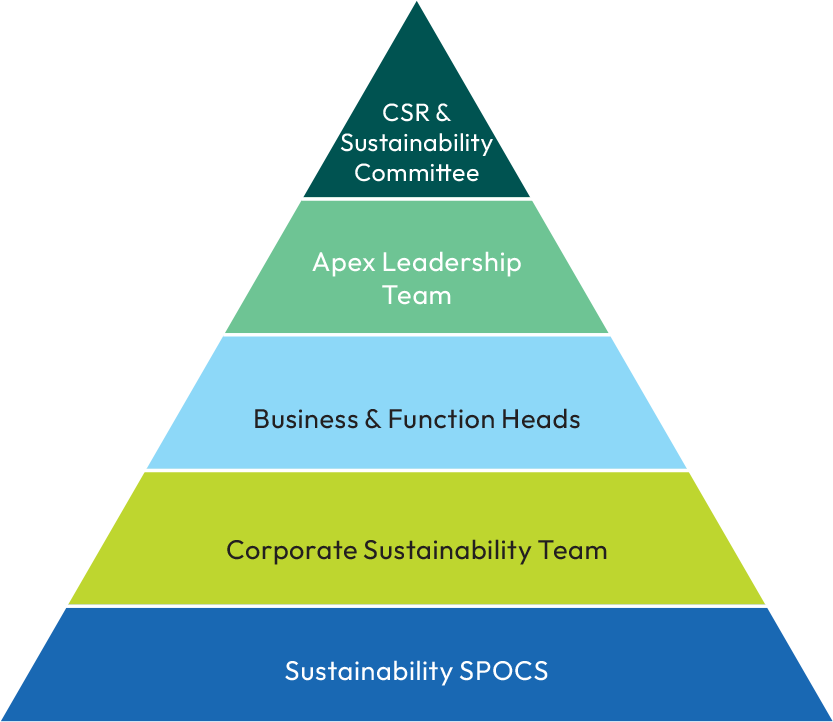
Our framework embeds sustainability across operations, initiatives, and ESG tracking, with performance reported to the Apex Leadership Team and CSR & Sustainability Board Committee for strategic guidance.

Leadership with care

- Environment conservation
- Efficient use of energy
- Investment in green technology


Initiatives that are based on and are encompassing
What needs to be done (material to both, five stakeholders and us)
What we are good at doing and is linked to our business objectives
What we should take up as national thrust areas and public-private partnerships for development and higher impact
What we should define as our standards, from compliance, to competing, to leading

Embedding ESG factors in business
Transition away from thermal operations by 2045 subject to the completion of contractual obligations and useful life
Pursuing new solar and hybrid capacities along with Round-the-Clock Renewable Power with pumped hydro plants and BESS
- Adopting best practices to become water neutral by 2030
- Zero Waste to Landfill by 2030
- Promoting mass adoption of rooftop solar, microgrids and home automation
- Leading EV charging infrastructure to spur ecosystem
- Value-Added Services (VAS) at the distribution end
- Ecosystem conservation activities at operating sites
- Implementation of Biodiversity Management Plans
- Spanning 100+ key geographies and 30+ aspirational districts/blocks
- Expand sustainable, future-ready practices through 4,000+ community institutions
- Improve Gender Diversity to 22% by 2030
- Roll out Water Stewardship as a marquee initiative, aligned with Project Aalingana, reaching 80,000+ beneficiaries annually in 5 years
- Enable 10+ lakh cumulative volunteering hours by 2030, strengthening employee engagement and community impact
Aligning our business and social interventions with the UN SDGs
Business SDGs
Business-wise targets have been set for the following prioritised SDGs to create a roadmap.
Decarbonisation
To become Net Zero by 2045

Thought leadership
To become a global sustainability benchmark
Circular economy
Move towards Water Neutrality and achieving Zero Waste to Landfill by 2030
CSR SDGs
Targets have been set for the following prioritised SDGs to create a roadmap for our CSR intervention areas.
Education
- Train 35+ lakh people in digital & financial inclusion by 2030
- Enable 8.8+ lakh Club Enerji & Pay Autention champions by 2030


Employability and employment
- 4+ lakh youth to be trained and made employable by 2030 with over 50% outreach to women
- Upskill & tech-enable 4,000+ Adhikaarpreneurs for 200+ regions with 15% special Tata Affirmative Action outreach
Entrepreneurship
- 47,000+ members under Anokha Dhaaga network by 2030
- Upskill 100+ Master trainers to cascade further to 5,00,000 members