



 CONTACT US


Badge of honor

Providing world-class solar solutions for over 36 years
Pioneering in cell and module manufacturing technology globally
Leading the way in completing the entire solar technology lifecycle
Shaping the future of indigenous cell and module production
Ensuring unwavering customer support every step of the way
One of India’s Largest Integrated Solar Manufacturers
BIS-Certified, MNRE-Approved Manufacturing
36+ Years of Solar Manufacturing Legacy
Building solar manufacturing in India with expertise
Through our advanced solar manufacturing capabilities in India, we deliver dependable performance, long-term value and clean energy solutions built to power India responsibly

Delivering quality
With decades of experience, we provide consistent quality, stable output, reduced service concerns, and long-term operational confidence.

Staying ahead of the curve
Our advanced modules are engineered for exceptional low-light output, long-lasting durability and high solar module efficiency, with customized solutions built for tomorrow’s energy demands.

Offering diverse solutions
With over 34 years of expertise, we deliver end-to-end solar solutions from rooftops to ground-mounted plants.

Ensuring affordability and sustainability
Our eco-conscious solutions lower your carbon impact and electricity bills, backed by high-quality products designed for long-term performance at competitive prices.
Setting solar manufacturing benchmarks
Rooted in purposeful innovation, our factories combine skill and scale to deliver dependable solar manufacturing expertise recognized across global markets
80%

women operators in manufacturing plant
4.9 GW
Cells and modules production capacity
3 GW
Modules shipped globally

Pioneering the next era of solar manufacturing

Maximizing production capacity
We are catering to the ever-growing demand for solar energy solutions through our massive scale, boasting a combined production capacity of 4.9 GW. Our facility in Bengaluru produces an impressive 650 MW of modules and 500 MW of cells annually, while our facility in Tamil Nadu has an astounding 4.3 GW capacity for cells and modules
Implementing innovative technologies
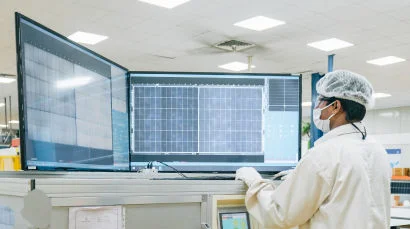
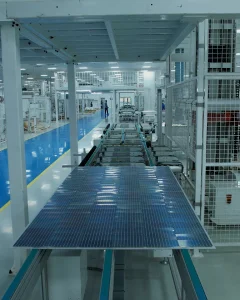
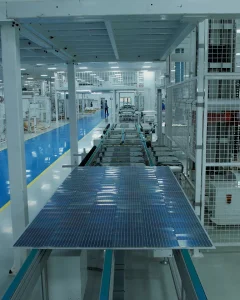
We are setting new benchmarks in solar manufacturing with our advanced plant in Tamil Nadu. It features Autonomous Mobile Robots (AMRs) for efficient part transportation and an interconnected system for real-time data monitoring, predictive maintenance, and streamlined workflows. The facility integrates Mono-PERC Bifacial and future n-Type TOPCON technologies to keep us at the forefront of solar energy advancements

Ensuring sustainable practices
We are dedicated to sustainable and responsible manufacturing, with a focus on minimizing environmental impact. Our Zero Liquid Discharge (ZLD) manufacturing lines conserve water, and our Safety, Health, and Environment department ensures compliance with our processes. Our comprehensive CSR programs support groundwater replenishment, educational initiatives, healthcare, and skill development
Certifications and quality assurance
We uphold ISO and IEC certified manufacturing standards, reinforcing our credibility as a trusted leader in India’s solar technology and module production



Sustainable is attainable
Every member of the Tata Group family upholds their commitment to community. Our efforts have touched over 40,000 lives through over 2.68+ lakh hours of volunteer work in FY 2023
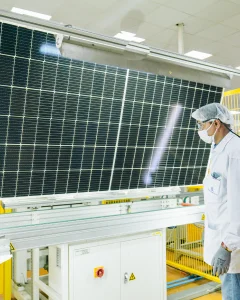
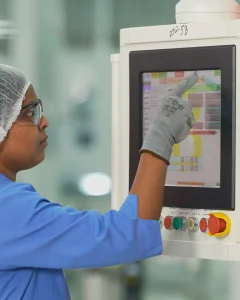
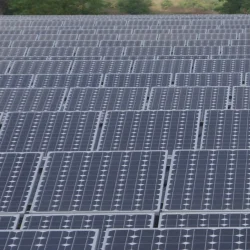
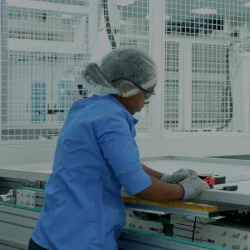
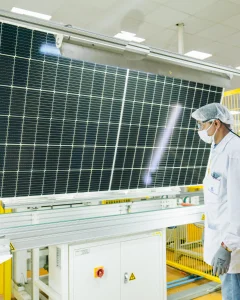
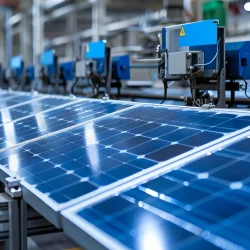
A glimpse of our manufacturing facility



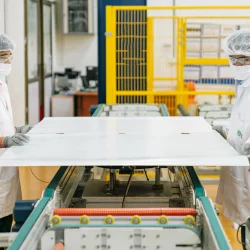
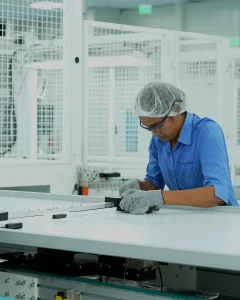
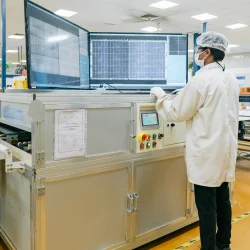
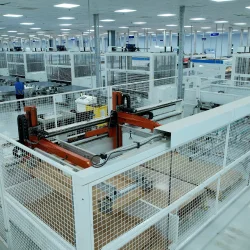


ISO 9001, ISO 14001 & ISO 45001
IEC 61215, 61730, 61701, 62716, 60068 UL61730
Integrated Cell and Module Manufacturing Facility Output

Frequently asked questions
The frequently asked questions section is a reliable source for unlocking answers to some of the most crucial inquiries. Please refer to this section for any queries you may have.
- FAQ
Solar manufacturing in India covers the entire value chain and is backed by rigorous standards and approvals. The process typically includes:
1. Producing silicon ingots and slicing them into wafers
2. Converting wafers into solar cells through doping, texturing and metallization
3. Assembling photovoltaic modules using cell stringing, lamination, framing and junction box integration
4. Conducting performance testing, certification and packaging prior to dispatch
These steps involve advanced engineering, quality control and large-scale production by a leading solar module manufacturer in India. They ensure dependable output and compliance with the Ministry of New and Renewable Energy’s Approved List of Models and Manufacturers (ALMM), supporting both domestic deployment and exports.
Tata Power is considered a leading solar module manufacturer in India because it combines scale, state-of-the-art technology and rigorous quality assurance. Its integrated cell-and-module facilities deliver around 4.9 GW of annual production capacity. It uses advanced automated manufacturing with Autonomous Mobile Robots and real-time data monitoring to stay ahead of the curve. The company meets international certifications such as ISO 9001, ISO 14001 and ISO 45001 along with IEC standards, reinforcing customer confidence in its solar manufacturing in India.
Here are the key steps in solar module manufacturing as recognized in India’s official value-chain mapping:
• Casting purified silicon into ingots and slicing into wafers.
• Processing wafers into solar cells by doping, texturing and metallisation.
• Assembling cells into strings, laminating between glass and back-sheet, applying frame and junction box.
• Final testing, quality inspection and packaging before dispatch under the framework for solar module production in India.
Several key factors influence solar module efficiency -
1. Cell efficiency depends on the material quality and design of the module’s solar cells.
2. Rising module temperatures reduce performance because higher heat increases internal electrical resistance.
3. Shading, dust accumulation and soiling on surfaces block sunlight and hamper module performance.
The angle and orientation of panels and the quality of sunlight exposure affect solar module manufacturing yields across India’s varied climate conditions.
Solar module efficiency determines how much of the sunlight hitting a panel is turned into electricity. Higher efficiency boosts solar module performance by enabling more power generation from the same area, which is crucial when installation space is limited. Improved conversion also means that systems achieve returns sooner and deliver greater lifetime output, making efficiency a key driver in energy yield and cost effectiveness.
India’s solar manufacturing capacity has achieved remarkable scale and momentum. According to the Ministry of New and Renewable Energy (MNRE) through the Approved List of Models and Manufacturers (ALMM), solar PV module manufacturing capacity has grown from just 2.3 GW in 2014 to over 100 GW by August 2025. Industry analysts project this to rise to approximately 165 GW by March 2027 as India scales up its value-chain and meets ambitious renewable targets. This surge underpins India’s push for self-reliant solar manufacturing and positions the nation as a major player in global photovoltaic manufacturing.
Reference link
1. https://www.pib.gov.in/PressReleasePage.aspx?PRID=2156173
India’s solar manufacturing capacity has surged dramatically over recent years. According to the Ministry of New and Renewable Energy (MNRE), module manufacturing capacity under the ALMM scheme climbed from just 2.3 GW in 2014 to 100 GW by August 2025. Independent analysis shows module capacity rose from approximately 72 GW in March 2024 to nearly 118 GW by July 2025. Looking ahead, projections estimate that by FY 2027-28 module capacity could hit around 200-220 GW.
Advanced solar manufacturing technology refers to the suite of high-precision processes, equipment and cell designs that drive greater efficiency, durability and production intelligence. For example, solar manufacturing tech by Tata Power includes Mono-PERC bifacial cells and n-type TOPCon technology, autonomous mobile robots (AMRs) for parts movement, real-time data monitoring for predictive maintenance and a fully integrated cell-and-module facility. These innovations allow the company to produce modules with enhanced low-light performance, superior life cycles and robust output - positioning them at the forefront of sustainable solar manufacturing in India.