
Introduction

Earth Hour 2026 brought the world together on March 28, as millions across 190+ countries switched off their lights in the Biggest Hour for Earth, marking 20 remarkable years of this global sustainability movement. In a world caught up in the rush of everyday life, that one hour served as a powerful reminder that collective action, however small, can change the world.

But what exactly is Earth Hour, and why is it celebrated year after year? What is the purpose behind switching off lights for just one hour, and how does a single symbolic act translate into real, meaningful change for the planet? As India's Bureau of Energy Efficiency continues to champion energy conservation across the country, Earth Hour stands as one of the most powerful global expressions of that very commitment. Before we dive into how the world celebrated in 2026, let us start at the very beginning.

What is Earth Hour?

Earth Hour is a global initiative aimed at encouraging people to take action against climate change. The event takes place on the last Saturday of March every year, where individuals, communities, and businesses turn off non-essential lights for one hour, from 8:30 PM to 9:30 PM local time. This simple act symbolizes a commitment to addressing pressing environmental issues like global warming, habitat destruction, and unsustainable energy use.

The meaning of Earth Hour is found in its collective message: that every small act, no matter how seemingly insignificant, can contribute to a global movement. The purpose of Earth Hour is to inspire a greater sense of responsibility toward sustainable living. It is a reminder that climate action does not always require grand gestures. Sometimes, the most powerful statement is made in the dark.

When was Earth Hour 2026 and what was the time in India?

Earth Hour 2026 was observed on March 28, bringing together individuals, communities, and businesses across the globe to switch off non-essential lights for one hour.


Date: March 28, 2026


Time: 8:30 PM to 9:30 PM (local time)


India Time: 8:30 PM to 9:30 PM IST


This coordinated action symbolizes a shared commitment to tackling climate change and promoting sustainable living.

Why is Earth Hour 2026 significant?

Earth Hour 2026 is significant because it marks 20 years of this global movement. What began as a single city switching off its lights in 2007 has grown into the world's largest environmental initiative, spanning more than 190 countries and territories. Two decades in, the Biggest Hour for Earth is more powerful than ever, and this year's event proved to be the most far-reaching yet.

Who started Earth Hour and what is its history?

Earth Hour was started by the World Wide Fund for Nature (WWF) in partnership with The Sydney Morning Herald in 2007 in Sydney, Australia. The idea was simple: switch off the lights for one hour to make a statement about climate change. As per WWF, the response was so overwhelming that over 2.2 million people and 2,100 businesses in Sydney participated in the very first Earth Hour.

What started as a grassroots movement quickly gained momentum, and by 2008, the concept of Earth Hour had gone global with 35 countries and over 400 cities joining in. People in cities across the world joined the effort, from the iconic Sydney Opera House to the Eiffel Tower.

The global impetus of Earth Hour highlights the true power of collective action, an idea best captured by Margaret Mead, who once said, “Never doubt that a small group of thoughtful, committed citizens can change the world; indeed, it's the only thing that ever has.”

Why is Earth Hour celebrated?

Earth Hour is celebrated because it brings millions of people together across the world to take a stand against climate change and support sustainable living. At its core, it goes beyond a symbolic lights-off moment by encouraging people to "Give an Hour for Earth", dedicating time to meaningful actions that contribute to a more sustainable future:

Together, these actions reflect a simple but powerful truth: sustainable living is not a sacrifice but a shared responsibility, and Earth Hour is the moment the world chooses to honor it

How did people participate in Earth Hour 2026?

People participated in Earth Hour by coming together to switch off non-essential lights and take small but meaningful steps toward more sustainable living:

  • Switching off non-essential lights: The switch-off is the heartbeat of Earth Hour. At 8:30 PM on March 28, people turned off every non-essential light in their home, office, or community space. It is a small act, but when millions do it simultaneously, it becomes a statement that governments, corporations, and climate negotiators cannot not ignore.
  • Unplugging and powering down: Lights are just the beginning. Appliances left on standby continue drawing power silently throughout the day. Earth Hour 2026 became an opportunity to audit spaces, unplug devices that were not in use, and become more intentional about how much energy households or workplaces consume on a daily basis.
  • Giving an hour for Earth: WWF's official call to action for 2026 is to "Give an Hour for Earth," which means doing something actively positive for the planet during that one hour. People went for nature walks, started compost bins, planted saplings, cooked zero-waste meals, or simply sat with their families and talked about what sustainability means to them. The action does not have to be grand to be meaningful.
  • Spreading the word: People shared their Earth Hour plans and participation on social media before, during, and after March 28. They tagged their communities, challenged their friends, and used their platforms to bring more people into the movement. Awareness is itself a form of action, and every post, story, or conversation that Earth Hour sparks is part of its impact.
  • Taking the pledge on the Tata Power Climate Crew App: In 2026, Tata Power launched a dedicated Earth Hour pledge page on its Climate Crew App, giving individuals and families a structured way to commit to sustainable actions, track their real-time impact, and even participate in an interactive mini game designed to make sustainability engaging for all ages.

And the action did not stop at the app. As a long-standing champion of environmental sustainability, Tata Power hosted a full slate of on-ground events and community initiatives planned across India for Earth Hour 2026.

Tata Power Climate Crew app Earth Hour 2026 India

Earth Hour 2026 brought people together in a shared moment of mindful action toward a more sustainable future

How did Tata Power celebrate Earth Hour 2026?

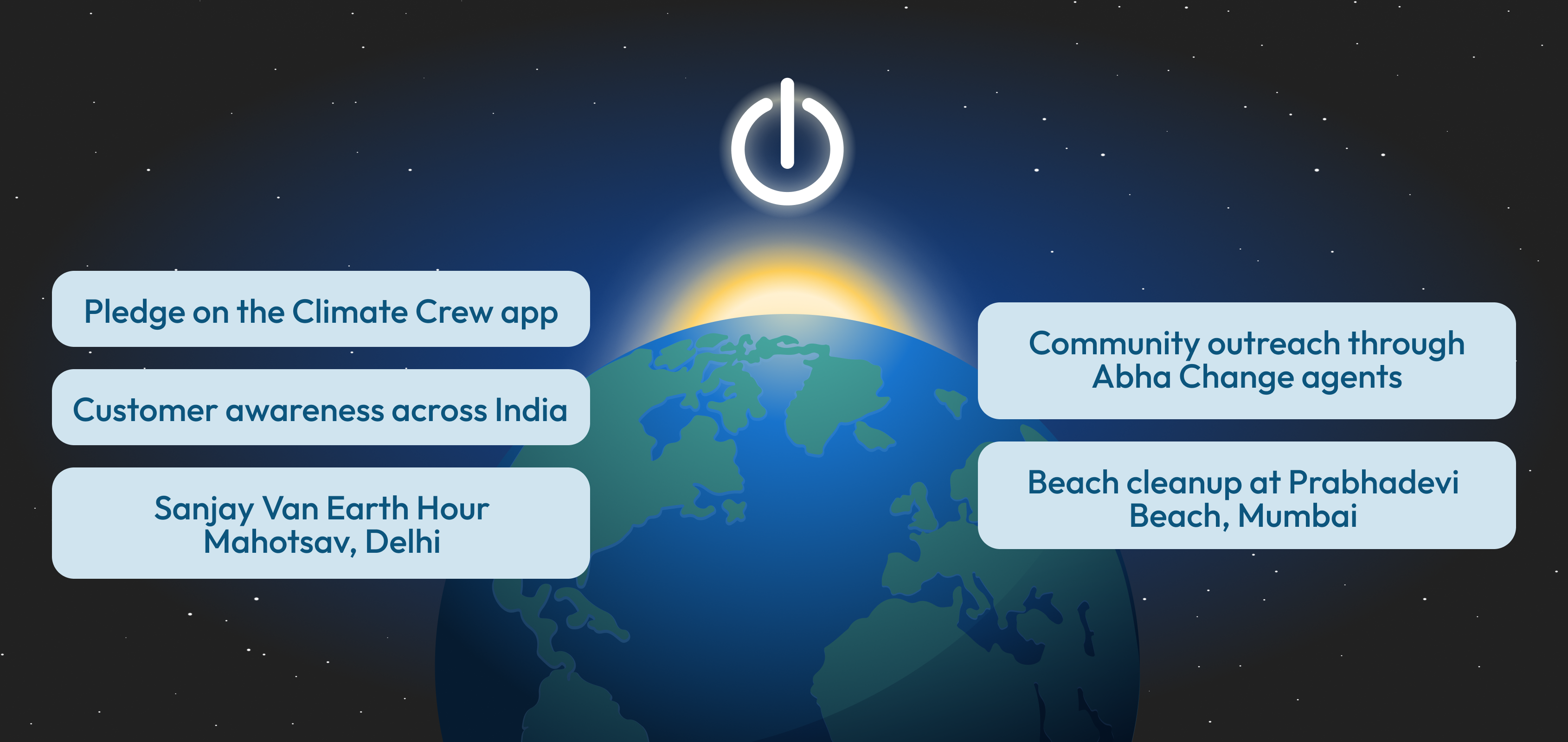
A pledge on the Climate Crew app

  • A dedicated Earth Hour pledge page was live on the Climate Crew App throughout the week of March 28, allowing employees and their families to formally commit to sustainable actions.
  • This year, Tata Power has introduced an interactive mini game alongside the pledge, complete with a set of sustainability tasks and an in-built impact tracking mechanism that lets participants see the real-time difference their actions are making.
  • Both the pledge page and the mini game are accessible through the Climate Crew App, available for download on Play Store or App Store.

Sanjay Van Earth Hour Mahotsav, Delhi

  • On March 28, 2026, Tata Power hosted the Sanjay Van Earth Hour Mahotsav in Delhi from 7:00 AM to 10:00 AM, bringing together nature lovers, families, and sustainability enthusiasts for a morning of immersive outdoor experiences.
  • Activities at the Mahotsav included a butterfly behavior walk led by Naturalist Dr. Surya Prakash, a macro photography workshop, a tracks and signs walk, a Sanjay Van history walk, nature journaling, Nature Through Games with nature educator and author Peeyush Sekhsaria, a yoga session in nature, a reading corner, and stone painting for conservation.
  • All Climate Crew members and their families came together to participate. The participants got in touch through the lead form available in the Sustainability section of the Tata Power website.

Beach cleanup at Prabhadevi Beach, Mumbai

  • In collaboration with WWF India, Tata Power organized a beach cleanup drive at Prabhadevi Beach, Mumbai on March 28, 2026.
  • Climate Crew members and their families were invited to participate, continuing a tradition of hands-on environmental action that has been a hallmark of Tata Power's Earth Hour participation in previous years.

Community outreach through Abha Change agents

  • Through its CSR network, Tata Power activated Abha groups across Delhi, Mumbai, and Odisha in the run-up to Earth Hour 2026.
  • In Odisha, Abha representatives educated community members about Earth Hour verbally while collecting bills, ensuring that the message of energy conservation reaches households at the grassroots level.
  • Informative posters and videos were shared across these communities for wider dissemination.

Customer awareness across India

  • Tata Power's commitment to Earth Hour extends well beyond its own workforce. The company encouraged its customers across India to switch off non-essential lights and appliances during Earth Hour, raising awareness through digital bills and customer care centers nationwide.
  • Club Enerji, Tata Power's student-focused sustainability initiative, played an active role in spreading awareness about energy conservation and sustainable living in the lead-up to March 28.


Through these efforts, Tata Power continues to play a pivotal role in India's transition toward green energy, demonstrating that sustainability and business growth are not competing priorities but complementary ones. Through their initiatives during Earth Hour 2026, Tata Power urges every individual, family, and organization to join the movement and make this the Biggest Hour for Earth yet.

If you’re looking to take your commitment a step further, you can explore Tata Power’s sustainable energy solutions and connect with our team to understand how you can make the switch to cleaner, more efficient energy for your home or business.

Ready to make your switch to sustainable energy? We’re here to help

Bottomline

Earth Hour is not just about turning off lights for one hour. It is about sparking a global movement that brings people together to address the most pressing environmental issues of our time. In 2026, as the world marked 20 years of this extraordinary initiative, every light switched off, every pledge taken, and every hour given to the planet was a vote for the kind of future we want to live in. As leaders like Tata Power continue to demonstrate that sustainability and progress are complementary forces, the movement only grows stronger. This Earth Hour 2026, millions across the world came together in making the Biggest Hour for Earth count.

Frequently asked questions

The frequently asked questions section is a reliable source for unlocking answers to some of the most crucial inquiries. Please refer to this section for any queries you may have.


The purpose of Earth Hour 2026 is to raise awareness about climate change and inspire people across the world to take meaningful action toward sustainable living.

As a global sustainability movement, Earth Hour encourages individuals, businesses, and governments to reduce their environmental impact by adopting cleaner energy practices and more mindful consumption habits. It serves as a reminder that collective action, no matter how small, can contribute to long-term environmental change.


Anyone can participate in Earth Hour 2026, including individuals, families, businesses, communities, and organizations across the world.

As a global sustainability movement, Earth Hour encourages participation from people of all ages and backgrounds. Whether at home, in workplaces, or across cities, anyone can take part by switching off non-essential lights and supporting energy conservation efforts. In India, Earth Hour has seen growing participation from households, institutions, and businesses alike, making it a truly collective initiative.


During Earth Hour, you should turn off all non-essential lights and electrical appliances from 8:30 PM to 9:30 PM local time.

This includes decorative lighting, unused room lights, and appliances that are not required during that hour. The idea is not just to reduce electricity use for that hour, but to reflect on everyday energy consumption and adopt more mindful habits. Following the Earth Hour date and time each year helps reinforce the importance of energy conservation in daily life.


While Earth Hour 2026 does not focus on a single defined theme, it marks 20 years of the global Earth Hour movement and its impact.

Over the years, the Earth Hour meaning has evolved to center around climate action, sustainable living, and collective responsibility. In 2026, the focus remains on encouraging people to go beyond the hour and take meaningful steps toward sustainability, reinforcing its role as a global sustainability movement that continues to grow in India and across the world.

Disclaimer:
The information provided in this blog has been compiled from multiple sources, including official company websites and other publicly available open-source platforms, believed to be reliable at the time of publication. However, such information may change over time, may not always reflect the most current developments, and may become outdated.
This content is intended solely for general informational purposes and should not be construed as professional, technical, financial, or legal advice. Tata Power does not guarantee the accuracy, completeness, or reliability of the information presented and shall not be held responsible for any loss or damage arising from reliance on this content.
Readers are advised to independently verify information from relevant official sources and conduct their own due diligence before making any decisions based on the content of this blog.