


 Contact us
Calculating EV charging time helps you charge smarter


Introduction
Before you hit the road or plug in your EV for the night, one practical question usually pops up first: how long will charging actually take? Many EV owners wonder how to calculate EV charging time, especially when different chargers, battery sizes, and efficiency factors come into play. The good part is that it is far less complicated than it seems. With a few basic numbers, charging stops feeling uncertain and starts becoming easy to plan.
Dive in for a simple formula that shows how to calculate EV charging time, a clear worked example that makes the numbers click, and a quick look at why real-world efficiency nudges estimates up or down. Prefer skipping the math? An EV charging time calculator can give instant estimates, while the insights here make it easier to plan drives, pick the right charger, and keep charging stress firmly off the dashboard.
How to calculate EV charging time before your next drive
Understanding how long it takes to charge your electric vehicle helps you plan better, whether you are heading out for a long drive or simply charging overnight. The good news is that the answer to how to calculate EV charging time is not complicated. With just a few numbers, you can estimate how long your EV will take to charge.
To estimate EV car charging time, you can use this simple formula -
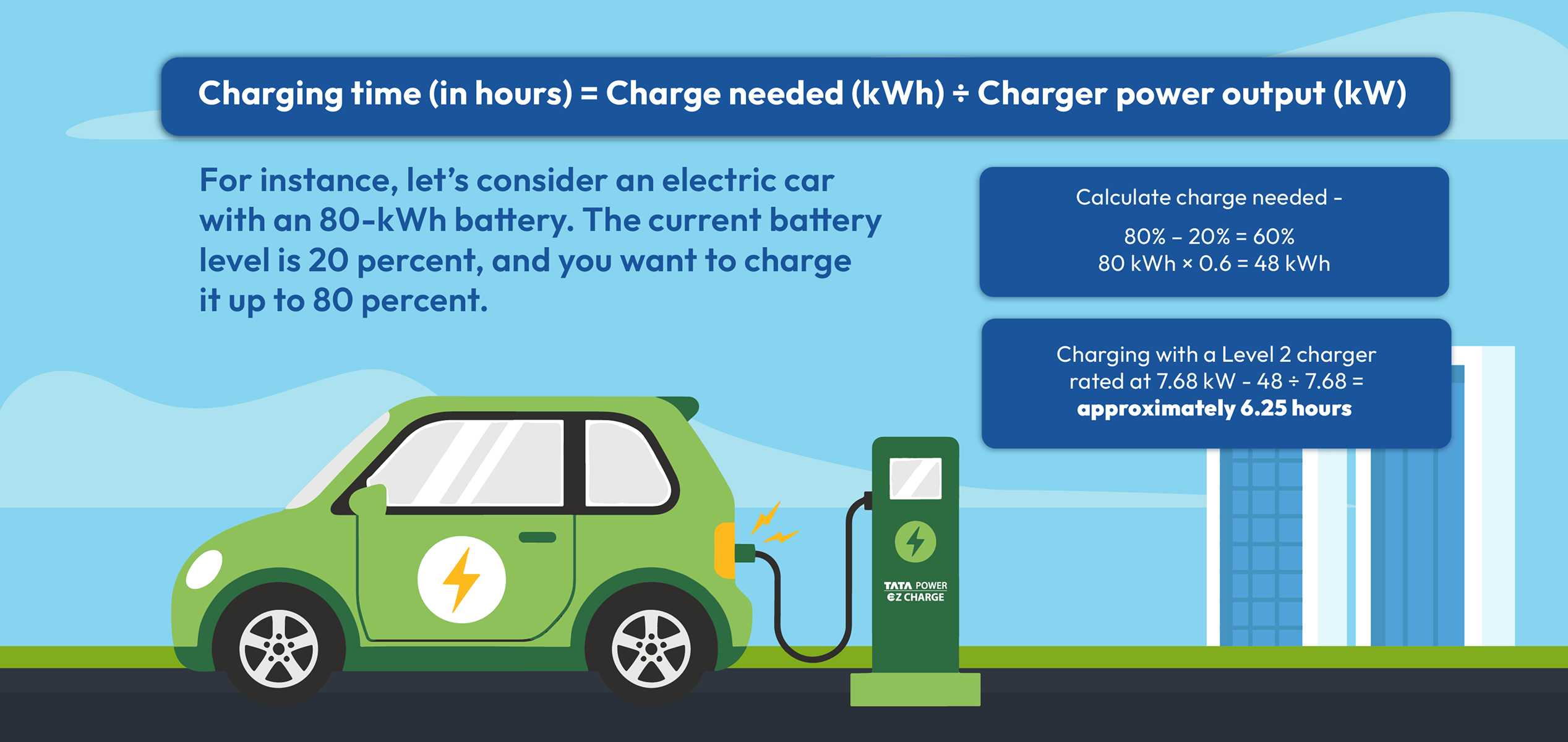
Charging time (in hours) = Charge needed (kWh) ÷ Charger power output (kW)
This gives you an approximate number of hours required to reach your desired battery level.
For instance, let’s consider an electric car with an 80-kWh battery. The current battery level is 20 percent, and you want to charge it up to 80 percent.
Calculate charge needed
80% – 20% = 60%
80 kWh × 0.6 = 48 kWh
Charging with a Level 2 charger rated at 7.68 kW - 48 ÷ 7.68 = approximately 6.25 hours
This is your estimated charging time for an EV using this charger setup.
Factoring in charging efficiency
Charging is not always 100 percent efficient. Some power is lost in the form of heat or during energy conversion. A good estimate is around 90 percent efficiency.
Adjusted formula
Charging Time = Charge Needed ÷ (Charger Power × 0.9)
Using the same example:
48 ÷ (7.68 × 0.9) = approximately 6.9 hours
This gives you a more realistic idea of your EV battery charging time.
Using an EV charging time calculator for confident EV planning
You can also use an EV charging time calculator available on NITI Aayog's e-Amrit portal. Enter the details like battery capacity(kWh), current battery level, desired battery level, charger power(kW) & efficiency (if known), and the EV charging time calculator will estimate the time taken to charge the electric vehicle for your specified conditions. Such calculators come in handy when planning road trips or comparing various chargers for use at home or the office.

Bottomline
Fueling up your EV shouldn’t feel like waiting around. Once the fundamentals become routine, even tasks that were once “techy” start to feel like a second nature. Being able to figure out EV charging time gives you one more layer of predictability– be that smoother daily driving or more reliable long trips. Knowledge means the difference between guessing and understanding your charging experience.
And when quick clarity is needed, an EV charging time calculator does the heavy lifting in seconds. A little awareness today can turn every future plug-in into a far more relaxed, confident experience on the road.
Disclaimer
The information provided in this blog has been compiled from multiple sources, including official company websites and other publicly available open-source platforms, believed to be reliable at the time of publication. However, such information may change over time, may not always reflect the most current developments, and may become outdated.
This content is intended solely for general informational purposes and should not be construed as professional, technical, financial, or legal advice. Tata Power does not guarantee the accuracy, completeness, or reliability of the information presented and shall not be held responsible for any loss or damage arising from reliance on this content.
Readers are advised to independently verify information from relevant official sources and conduct their own due diligence before making any decisions based on the content of this blog.
Frequently asked questions
The frequently asked questions section is a reliable source for unlocking answers to some of the most crucial inquiries. Please refer to this section for any queries you may have.
- FAQ
The estimates are based on ideal charging conditions remaining constant, but conditions change during charging. Ambient temperature on the battery, load sharing from the charger, and charging limits in the vehicle will impact speed. Studies into EV infrastructure have pointed out that vehicle limits for preserving battery health will dynamically modify charging speed as needed. Therefore, these are approximate best/worst-case directions.
Yes, charging off of lower voltages takes longer than charging batteries that have been partially charged already. Charging also typically slows as you reach higher percentages to maintain battery longevity. Both of these things are well studied when it comes to EV battery management systems and will affect any time calculation
Manual calculations allow you to learn about the dynamics of charging. An EV charging time calculator enables quick estimates. The reason most official EV mobility platforms come with calculators is that they simplify things while being acceptably accurate for planning.
The equation stays consistent, but charger ratings do not. Residential units tend to offer consistent overnight charging, while public fast chargers can offer higher wattage but inconsistent output. Scaling charger wattage within the calculations allows for more realistic predictions based on each situation.
Yes, eventually. Battery capacity could decrease slightly over time, changing the charging algorithm. Although EV batteries last for years without issue, recalculating them occasionally verifies that charge expectations are accurate on older cars.

Sources
1. e-AMRIT (Accelerated e-Mobility Revolution for India's Transportation) portal – Niti Aayog
2. HOME CHARGING CALCULATOR – NITI AAYOG
3. Electric vehicle charging
4. INTEGRATION OF ELECTRIC VEHICLES CHARGING INFRASTRUCTURE WITH DISTRIBUTION GRID
5. A review of the electric vehicle charging technology, impact on grid integration, policy consequences, challenges and future trends
6. PUBLIC CHARGING CALCULATOR – NITI AAYOG
7. STANDARDS AND SPECIFICATIONS – E-AMRIT
Keep reading...
View all