


 Contact us
Power transmission and distribution ensure uninterrupted supply of electricity


Introduction
India’s total installed electricity capacity crossed 500.89 GW on 30 September 2025, and the power transmission and power distribution systems are the networks that carry this energy across power grids in India from power plants and renewable parks to homes, hospitals and factories. Transmission forms the high-voltage spine that moves bulk power across states, while distribution steps voltage down and handles the last mile. Together they decide how reliable and affordably electricity reaches people.
This blog explains the practical difference between transmission and distribution, why that difference matters for utilities, consumers and planners, and how India is upgrading the network to meet a faster clean-energy rollout.
Read on and know how India powers itself in today's time.
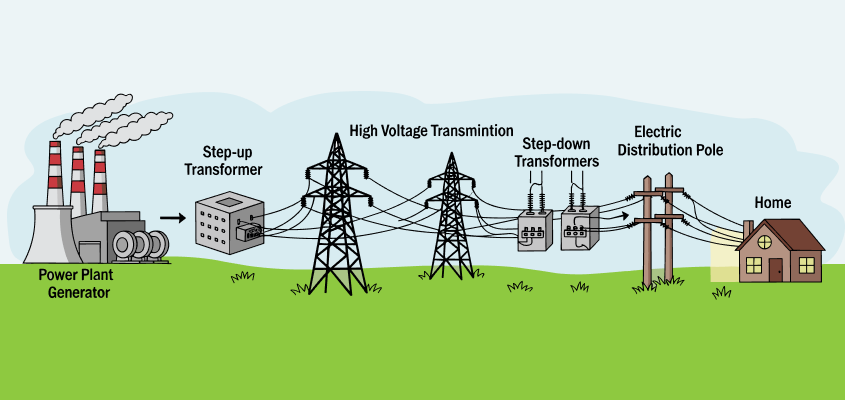
The key differences between power transmission and distribution
Understanding the difference between power transmission and distribution gives clarity on how electricity moves from generation to everyday use across India
| Aspect | Power transmission | Power distribution |
|---|---|---|
| Definition | Power transmission is the high-voltage network regulated by central transmission utilities that help move electricity from power plants to regional substations across states. | Power distribution is the lower-voltage network managed by state distribution companies that steps down electricity from substations and delivers it to homes, offices and industries for everyday use |
| Role in T&D sector | Moves large amounts of electricity from generation sites to major substations, keeping the power grid balanced across distant regions | Delivers lower voltage power from substations to homes and businesses, managing supply quality, billing and everyday consumer connections |
| Voltage | Operates at extra high voltage levels, usually 220 kV, 400 kV and sometimes 765 kV AC. Certain long corridors may also use HVDC to move power efficiently across states and reduce losses over long distances | Works with medium and low voltages such as 33 kV and 11 kV feeders, which are then stepped down further to 415/230 V for homes, shops and industries |
| Equipment | Uses large grid transformers rated in hundreds to thousands of MVA, protection relays, series of compensation devices and long-span towers. Built to prevent regional blackouts and ensure faults can be isolated quickly | It relies on pole-mounted or pad-mounted transformers, local distribution switchgear, LT and HV conductors, and consumer meters. In many cities, parts of the network use underground cables for public safety and convenience |
| Operational framework | Central agencies plan and oversee interstate transmission, set standards, and coordinate flows, while state utilities manage intra-state extra high voltage networks | Run by state DISCOMs and regulated locally, distribution manages tariffs, service standards and customer operations through large on-ground teams |
| Performance | Tracks EHV line length, substation capacity, transmission losses, congestion and grid availability, using SCADA and wide-area systems for continuous monitoring | Tracks feeders, transformers, reliability metrics like SAIFI and SAIDI, and AT&C losses, which determine a DISCOM’s financial strength and upgrade capability |
| Challenges | Land acquisition, corridor clearances, long construction schedules, and maintaining stability across interconnections. Managing reactive power, frequency, and large power transfers requires careful coordination | Asset ageing at the local level, overloaded transformers, meter tampering, illegal connections and weak billing and collection processes. These create both supply problems for customers and financial stress for utilities |
| Clean energy integration | Dedicated projects such as the Green Energy Corridor are built to connect renewable hubs into the interstate grid and reduce grid collapses | Manage two-way flows from rooftop solar, maintain local voltage, and enable net-metering. Distribution networks must be adapted to handle reverse electricity flows and rapid change at the local level |

Bottomline
Electricity reaching your home is not a simple process. It travels hundreds or thousands of kilometers from remote generation plants through high-voltage transmission lines and then moves through a distribution network to deliver usable power at safe voltages. Power transmission and distribution are two distinct but interlinked parts of a larger system. In India, transmission is handled centrally for long-haul transport and distribution typically at the state or local level for final delivery. Each has its own infrastructure, challenges, and roles. Together they ensure that when you flip a switch, your light turns on despite the complex journey behind the scenes
Frequently asked questions
The frequently asked questions section is a reliable source for unlocking answers to some of the most crucial inquiries. Please refer to this section for any queries you may have.
- FAQ
Revamped Distribution Sector Scheme (RDSS) is a plan launched by the Indian Government to improve the quality and reliability of electricity supply by upgrading distribution networks and making distribution companies financially strong. Under the scheme, state utilities (DISCOMs) receive financial aid only if they meet performance targets. Because of RDSS, many local lines and transformers are being upgraded, and prepaid smart meters are being installed to reduce losses and ensure accurate billing
Large-scale green power needs new grid infrastructure. India’s “Green Energy Corridor” project is building dedicated high-voltage transmission lines to connect solar and wind parks to the national grid. This includes thousands of circuit-km of extra-high-voltage lines and substations in renewable-rich states. These corridors, along with storage and reactive compensation systems, help evacuate clean power to load centers
Not always. Transmission infrastructure handles high-voltage lines and long-haul connections, but distribution faces bigger costs because of energy losses and revenue shortfalls. In 2023-24 India’s overall T&D losses stood at about 15.4 percent nationwide. Because distribution must deliver power to individual homes and businesses and handle billing, metering and maintenance, its per-unit cost often rises more. That means distribution sometimes ends up being more expensive than transmission for utilities, and that impacts consumer bills too
T&D losses refer to electricity lost between when it is generated and when it is delivered to consumers. Losses occur partly from physical inefficiency of wires and equipment (technical losses) and partly from theft, faulty meters or unbilled supply (commercial losses). Official data shows India’s nationwide transmission and distribution losses fell from about 23 percent in 2014–15 to roughly 17 percent in 2023–24
India’s interstate transmission grid is mainly built and run by central utilities (e.g. Powergrid Corporation of India). State transmission utilities (STUs) also handle intra-state high-voltage lines. Distribution is handled by state-level DISCOMs or private franchisees. Under the Constitution (Concurrent List), distribution is a state-led responsibility. State electricity regulatory commissions set up local tariffs for distribution
Several schemes target distribution reform -
1. The UDAY program (2015) helped bail out DISCOM debt and incentivized loss reduction.
2. In 2021, the Revamped Distribution Sector Scheme (RDSS) launched a ₹3.03 lakh crore outlay for smart meters and network upgrades. RDSS disburses funds only if utilities meet milestones.
Earlier schemes like DDUGJY (rural feeders), IPDS (urban networks) and Saubhagya (household electrification) also upgraded infrastructure. These are bolstered by smart-grid technologies (advanced metering, SCADA) to reduce losses
Sources
1. India achieved Historic milestone in power sector: Surpasses 500 GW and Renewable Generation Exceeds 50% of demand
2. Government of India launches Revamped Distribution Sector Scheme (RDSS) to reduce the Aggregate Technical & Commercial (AT&C) losses to pan-India levels
3. The Electricity (Amendment) Bill, 2022
4. Green Energy Corridor
5. Implementation of Ujwal Discom Assurance Yojana (UDAY)
6. National Level AT&C Losses in Power Network down from 22.3% in 2020-21 to 16.4% in 2021-22

Keep reading...
View all