When it comes to types of transmission lines, we can classify them in a couple of ways. One way is by their physical configuration or environment, and another way is by the length of the line, which affects how the line is designed and operated. Below, we explore each category, highlighting how they work and where they’re used in India’s power system.
Overhead transmission lines
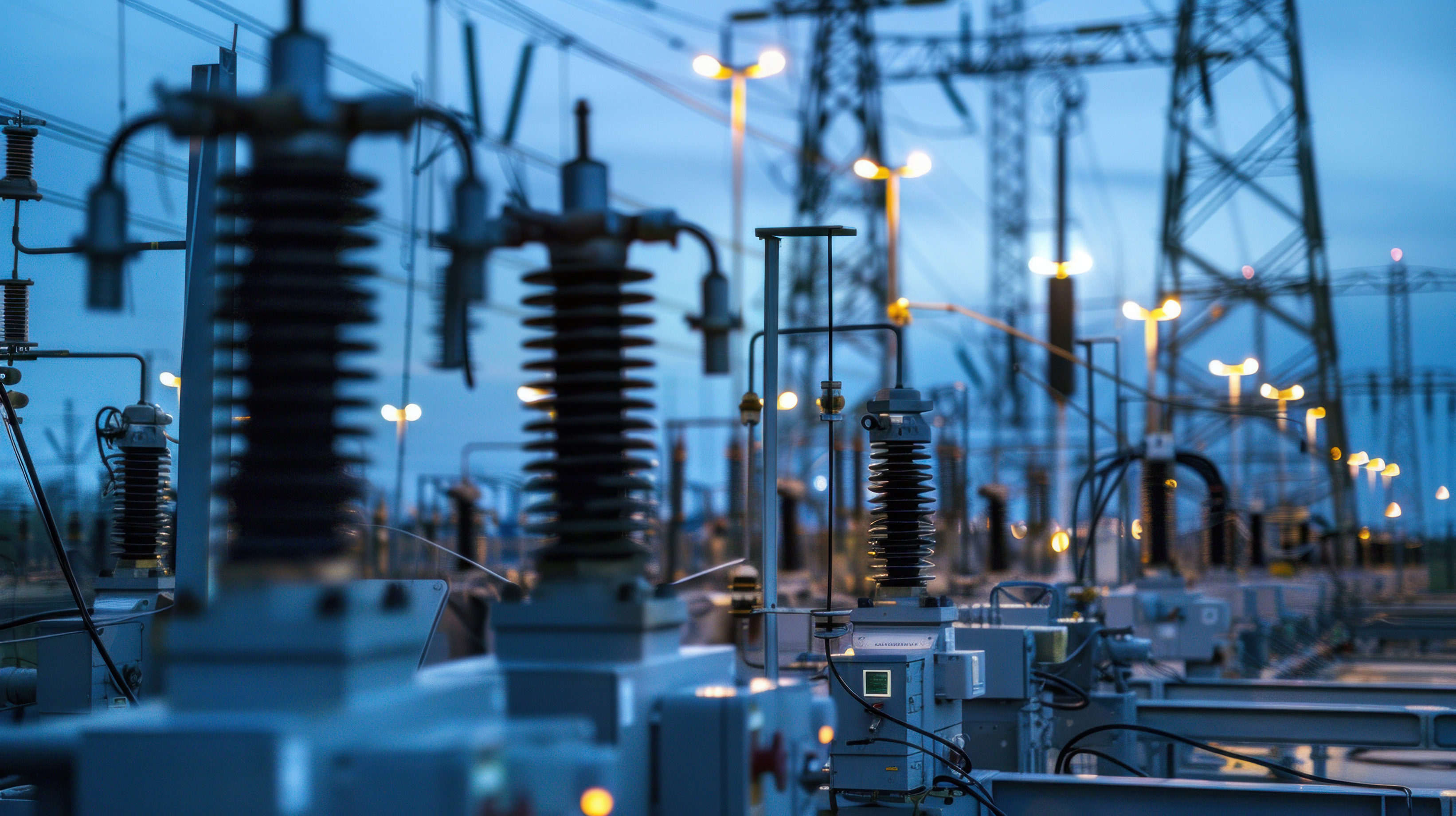
Overhead power lines are the classic transmission lines you see on lattice steel towers or poles, using open-air as natural insulation. They are the default choice for long-distance power transmission in India because they are relatively inexpensive to build and can carry very high voltages such as 220 kV, 400 kV, 765 kV and above. Under a government scheme, over 33,000 circuit kilometers of new overhead lines were added to improve grid reliability.
Advantages of overhead transmission lines
1. Lower construction cost compared to other transmission methods.
2. Easier and faster to install.
3. Simpler to repair and maintain.
4. Exposed conductors allow quick fault detection and access for maintenance crews.
5. Can span long distances efficiently.
6. Capable of linking multiple states with high-voltage connections (400 kV and 765 kV).
Challenges
1. Vulnerable to weather: High winds, storms or lightning can knock down overhead power lines or induce faults. Utilities install lightning arrestors and keep proper clearance distances to prevent outages.
2. Land and visual impact: Overhead lines need a right-of-way corridor and are visible in the landscape, which can raise environmental and aesthetic concerns.
Underground transmission lines
As cities grow and open land becomes scarce, underground transmission cables play an important role, especially in urban and sensitive areas. These lines use insulated high-voltage cables buried in trenches or tunnels instead of hanging in the air. They stay hidden from view and shielded from weather, boosting safety and reliability in dense city centers. In Mumbai and Delhi, many 110 kV or 220 kV lines run underground to deliver power without cluttering the skyline. One such example is Tata Power’s Mumbai transmission project that involved setting up more than 1,287 ckt km of transmission network with 30 substations to meet the ever-growing power needs of the city.
Under the IPDS scheme, over 75,000 ckm of underground or aerial bundled cables were installed to cut losses in Indian towns. In Bengaluru, several neighborhoods converted overhead wires to underground cables in a Tata Power project to improve safety and reduce outages.
Challenges
1. High installation cost: Underground cables and excavation work can make costs two to four times higher than overhead lines.
2. Complex installation: Laying high-voltage cable under city streets often requires digging up roads, navigating water and gas pipelines and restoring the surface, driving up time and expense.
3. Tricky maintenance: Locating and repairing a buried fault can take days or weeks since the cable is out of sight.
4. Technical limits: Long AC cables build up significant capacitance and large charging currents, which hinder efficient power transfer and voltage control.
5. Distance constraint: AC cables longer than about 50 to 80 km become impractical, so engineers use HVDC technology for very long underground links.
6. Limited application: Underground transmission cables are mainly used in urban areas or eco-sensitive zones where overhead lines are not viable.
Submarine power transmission cables
Submarine transmission lines are essentially underground cables deployed underwater. These undersea power cables or HVDC submarine cables allow electricity to be transmitted across straits, rivers, or even open ocean where overhead lines can’t be built. Submarine cables are often high-voltage direct current (HVDC) systems because DC avoids the length limitations of AC underwater cables. A notable example is the proposal to connect India and Sri Lanka’s power grids.This project involves a 285 km HVDC link with roughly 50 km of submarine cable through the Palk Strait. By using an undersea cable, the two countries can exchange power despite being separated by the sea.
Another example is the planned ±320 kV HVDC undersea high voltage transmission system to link Pradip (Odisha) to Port Blair (Andaman & Nicobar Islands), spanning about 1,150 km under the Bay of Bengal. This ambitious project, outlined by the Central Electricity Authority, will be the first of its kind in India - a 250 MW high voltage HVDC submarine cable power transmission to reliably power the remote Andaman Islands by 2029-30.
Challenges
1. Complex engineering: Submarine HVDC cables must be heavily insulated, armored and buried in the seabed to withstand ocean currents and protect against ship anchors.
2. Specialized installation: Laying cables under the Arabian Sea from Gujarat to the Middle East demands advanced cable-laying vessels and meticulous route surveys.
3. High cost: Manufacturing and installing submarine transmission cables for a roughly 2,000 MW link under the “One Sun One World One Grid” initiative is very expensive.
Small transmission lines
A short transmission line refers to a line up to about 80 km. They operate at voltages like 66 kV, 110 kV or 132 kV to link nearby areas, such as a power plant to a city or two substations within a region. Because line capacitance and capacitive charging current are minimal, engineers treat shunt capacitance as negligible and simplify analysis by considering only resistance and inductance. These single-circuit or double-circuit lines run on simple tower structures. Their shorter span keeps voltage drop and power losses small, making regulation easier.
Many intra-city or intra-district lines in India, especially at 66 kV or 132 kV, fall into this category. Short lines are essential to the grid, strengthening local networks and providing redundancies.
Medium transmission lines
Medium transmission lines typically span around 80 km up to 200–250 km. These medium transmission corridors carry power at voltages such as 132 kV, 220 kV or 230 kV across moderate distances, like a 132 kV line linking two cities 150 km apart. Because line capacitance becomes noticeable at these lengths, charging current affects voltage and reactive power flow, so engineers use nominal π or T models to distribute capacitance in calculations. To manage voltage levels, equipment such as shunt reactors or capacitors is installed at line ends.
India’s grid relies heavily on medium-length lines, especially at 220 kV, forming the regional backbone that connects power stations and state grid hubs. These lines often run on robust lattice towers and may use twin or triple conductors per phase (bundled conductors) to increase capacity. Medium transmission lines balance coverage and complexity: they bridge regions without requiring the advanced methods used for ultra-long lines.
Long transmission lines
Transmission lines over about 200-250 km are considered long transmission lines. These cross-country high-voltage corridors often use 400 kV and 765 kV AC lines or high-capacity HVDC links. For example, a 765 kV AC line carries power from a thermal plant in Odisha to Gujarat across more than 500 km, while India’s ±800 kV Raigarh - Pugalur UHVDC link spans 1,830 km, making it among the world’s longest transmission lines.
Long lines require precise modelling because resistance, inductance and capacitance are distributed continuously along their length. Engineers apply rigorous long-line models to solve wave propagation and address issues such as line charging, voltage drop and stability limits. For AC routes, reactive power is managed with series capacitors, shunt reactors or Flexible AC Transmission Systems devices.
In practice, HVDC becomes more economical beyond about 400-500 km for overhead lines or 50 km for submarine cables due to lower losses and absence of reactance. India also uses the ±800 kV North-East Agra HVDC link to move hydro power over 1,728 km. These long corridors serve as electricity superhighways, uniting regional grids into a national network and delivering renewable power from solar parks in Rajasthan or wind farms in Tamil Nadu to distant consumers.




 Contact us