


 Contact us
Carbon credits put measurable value on reducing greenhouse emissions


Sections
- Introduction
- What are carbon credits?
- How are carbon credits generated?
- How do carbon credits work?
- What are the benefits of carbon credits?
- What are the different types of carbon credit markets?
- Clean power or carbon impact? Understanding RECs and CCCs
- How is the carbon credit market being implemented in India?
- Bottomline
- FAQs
- Sources
Introduction
What are carbon credits, and why is a tonne of avoided emissions now something businesses can measure, trade, and value? In 2026, direct carbon pricing covers just over 29% of global greenhouse gas emissions, while carbon-credit issuances rose 8% in 2025. Climate action is no longer discussed only through targets; it is increasingly being translated into accountable, market-linked outcomes.
Carbon credits sit at the heart of that shift. These tradable certificates turn verified reductions and removals into financeable outcomes, connecting climate ambition with projects that deliver it. But the real story is not a certificate. It is whether markets can move capital towards lower-emission industries, restored ecosystems, and measurable progress. This blog explores how.
What are carbon credits?
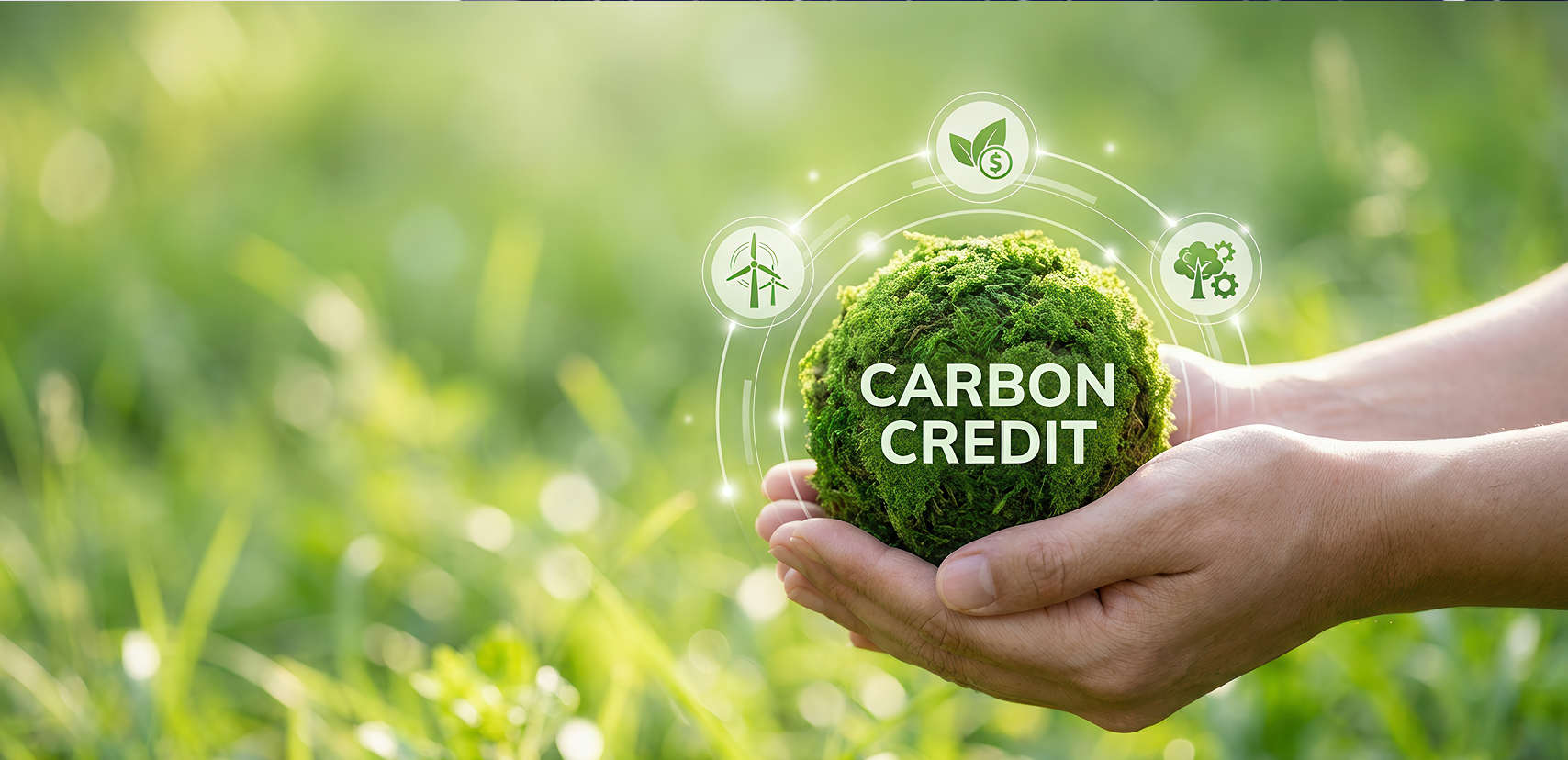
A carbon credit is a tradable certificate representing one metric tonne of greenhouse gas emissions reduced, avoided, or removed from the atmosphere, measured as carbon dioxide equivalent (tCO₂e). CO₂e converts the warming impact of gases such as methane and nitrous oxide into a carbon dioxide-based unit.
Carbon credits are generated through activities that follow approved methodologies, establish baselines, and demonstrate additionality where required. They are issued only after the claimed climate benefit is measured, documented, and verified under an approved system.
How are carbon credits generated?
Carbon credits are generated through projects that deliver measurable climate benefits, including renewable energy, industrial efficiency, landfill methane capture, and afforestation, before following a structured pathway to verified registry issuance.
1. Identify an eligible project
The developer identifies an eligible project capable of reducing or avoiding greenhouse gas emissions or removing them from the atmosphere.
2. Prepare the project design
A project design document sets out ownership, the baseline, approved methodology, expected climate benefit, calculations, and monitoring plan.
3. Complete independent validation
An accredited independent agency checks the project’s eligibility, methodology, baseline, and additionality requirements, where applicable, before registration.
4. Register the project
The programme administrator reviews the validated documents and formally registers the project under the recognized carbon-credit programme.
5. Implement and monitor
The registered project begins operating and records the data needed to track its climate impact over a defined monitoring period.
6. Verify the results
An accredited verifier examines the monitored data and calculations, confirming the achieved climate benefit and the eligible quantity of credits.
7. Issue the credits
After reviewing the verification report, the programme issues approved credits electronically into the project developer’s registry account.
How do carbon credits work?
Carbon credits do more than recognize climate action; they give it a route into the economy. The following steps show how that verified value moves through the market in practice.
1. After credits are issued, they can be sold to a buyer through an approved market or trading platform.
2. A company may buy them to meet a regulatory obligation or support a voluntary climate goal.
3. Ownership is transferred through a registry that tracks each unit.
4. When a credit is finally used, it is retired so that it cannot be sold, transferred or claimed again by another buyer.
What are the benefits of carbon credits?
Carbon credits can do more than reward lower emissions. Their wider value lies in unlocking finance, accelerating cleaner choices, strengthening accountability, and supporting credible climate action across industries and ecosystems.
Carbon-credit revenue can improve the economics of projects involving cleaner technology, clean energy, methane capture, or ecosystem restoration, helping eligible climate action attract investment.
Turning lower emissions into investable progress
A credible system rewards measured reductions rather than broad promises. Funds can flow to projects that demonstrate how much greenhouse gas they have reduced, avoided or removed
Backing climate action that can prove its impact

When lower emissions carry financial value, businesses have an added reason to reduce energy use, upgrade equipment, improve processes, and adopt lower-carbon technologies
Accelerating efficiency and low-carbon innovation

Some industries cannot eliminate every emission immediately. Carbon markets can help them meet part of their obligations while direct decarbonization technologies continue to develop.
Supporting industries while sustainable alternatives

Depending on the project, carbon credits may also support jobs, cleaner air, improved waste management, stronger ecosystems, better energy access, or more resilient livelihoods
Creating impact far beyond lower emissions

Clear baselines, monitoring, reporting, verification, and registry tracking make emissions performance easier to measure and reduce the risk of the same climate benefit being claimed twice.
Putting proof behind every climate claim

What are the different types of carbon credit markets?
Compliance carbon market
A compliance carbon market is created through law or regulation. Covered organizations must meet specified emission limits or emission-intensity targets. Those that perform better than required may receive or sell eligible units, while those that fall short may need to buy and surrender them. The regulator decides who participates, which units are accepted, and how compliance is assessed.
Voluntary carbon market
A voluntary carbon market allows businesses, institutions, or individuals to purchase credits without a legal requirement. Buyers may use them to support climate commitments or address emissions they have not yet eliminated. Because participation is voluntary, credit quality depends heavily on credible methodologies, additionality, independent verification, transparent registries, and safeguards against double-counting.
Clean power or carbon impact? Understanding RECs and CCCs
Renewable energy certificates
A renewable energy certificate represents the environmental attribute of renewable electricity generation. In India, one REC corresponds to one megawatt-hour of renewable electricity generated and injected, or deemed injected, into the grid, subject to certificate multipliers. RECs primarily support Renewable Purchase Obligation compliance and voluntary renewable electricity procurement; they do not directly certify one tonne of avoided greenhouse gas emissions.
Carbon credit certificates
A carbon credit certificate represents a greenhouse gas outcome, not electricity generation. Under India’s carbon credit trading scheme, one CCC equals one tonne of carbon dioxide equivalent reduced, removed, or avoided. CCCs may be issued through the compliance or offset mechanism and traded in the Indian carbon market. Their value depends on emissions’ performance measured against targets, baselines, and methodologies.

Certified carbon reductions turn climate action into credible proof
How is the carbon credit market being implemented in India?
India’s carbon market has progressed from policy intent to market infrastructure in just four years. After the Ministry of Power notified the Carbon Credit Trading Scheme in 2023, BEE developed operating procedures and verifier-accreditation rules in 2024. The framework moved closer to execution in 2025 as industry targets and project-crediting methodologies took shape. In 2026, the launch of the Indian carbon market portal created a central platform for participation and future trading.
Administered by BEE, with emission-intensity targets notified through the Ministry of Environment, Forest and Climate Change, the CCTS brings regulated industries and voluntary climate projects under one national framework. It is designed to translate verified greenhouse gas reductions, removals, and avoided emissions into tradable Carbon Credit Certificates.
| Parameters | Impact |
|---|---|
| Obligated entities covered | 490 |
| Energy-intensive sectors under the notified targets | 7 |
| Market mechanisms | 2 |
| Approved carbon offset methodologies | 12 |
| Registered entities submitting projects by March 2026 | 40+ |
1. Compliance mechanism: reducing industrial emission intensity
- Under India’s compliance mechanism, notified energy-intensive industries receive greenhouse gas emission intensity targets based on emissions per unit of output.
- Entities that outperform their targets may earn Carbon Credit Certificates, while those falling short must purchase and surrender certificates to cover the gap.
- The mechanism currently covers 490 obligated entities across aluminium, cement, chlor-alkali, pulp and paper, petroleum refineries, petrochemicals, textiles, and secondary aluminium, enabling flexible compliance through certificate trading.
2. Offset mechanism: creating credits through eligible projects
- The offset mechanism allows non-obligated entities to voluntarily register projects that reduce or avoid greenhouse gas emissions, or remove them from the atmosphere, against an approved baseline.
- Eligible activities include renewable electricity, green hydrogen, industrial efficiency, fuel switching, landfill methane recovery, compressed biogas, improved rice cultivation, livestock methane recovery, biomass energy, afforestation, and reforestation.
- Credits are issued only after methodology, monitoring, and independent verification requirements are met, helping ensure each certificate represents a measurable, traceable, and credible genuine climate outcome.
Scratch. Reveal. Learn
A small swipe. A big reveal.
Bottomline
For decades, the economy placed a price on what we extracted, produced, and consumed. The carbon credit market introduces a different possibility: placing value on emissions prevented, methane captured, forests restored, and cleaner choices made.
So, what are carbon credits in the larger sustainability story? They are a way to make genuine climate progress visible, financeable, and accountable. As carbon credits in India move from policy into practice, success will not be measured by how many certificates are traded. It will be measured by what changes beyond registries, in our industries, our ecosystems, and the future we leave behind.

Frequently asked questions
The frequently asked questions section is a reliable source for unlocking answers to some of the most crucial inquiries. Please refer to this section for any queries you may have.
- Solaroof
No, carbon credits and carbon offsets are not the same. They are closely related, but both describe different stages. A carbon credit is a tradable unit representing a verified tonne of greenhouse gas reduced or removed. Once that unit is purchased, retired, and used to compensate for emissions elsewhere, it functions as an offset. In simple terms, the credit is the asset; offsetting is the claim made when that asset is permanently taken out of circulation.
Carbon credit prices vary globally. Prices vary according to market type, project category, location, vintage, methodology, verification standard, demand, supply, and eligibility for a particular compliance programme. Credits with stronger integrity assessments or additional social and environmental benefits may command premiums. In regulated systems, exchange trading and market rules support price discovery; in voluntary markets, buyers and sellers negotiate values based on quality and demand.
Carbon credits can support climate action beyond a company’s value chain, but they cannot replace deep cuts to operational and supply-chain emissions. Under SBTi (Science-based Targets Initiative) guidance, companies should prioritize science-based reductions and may finance additional mitigation during the transition. At the net-zero target year, any remaining residual emissions must be neutralized through permanent carbon removals. Credits, therefore, play a supporting role, not a shortcut to a credible net-zero claim.
Yes, but international use depends on the rules governing the credit and the purpose for which it is bought. Article 6 of the Paris Agreement allows countries to cooperate by transferring authorized mitigation outcomes. Where a reduction is counted towards another country’s climate target, corresponding adjustments help prevent both countries from claiming it. Credits used for airlines, compliance systems, or voluntary claims may also face separate eligibility and authorization requirements.
Carbon credits are designed to place a measurable financial value on verified climate outcomes. By converting greenhouse gas reductions or removals into tradable units, they help channel finance towards mitigation activities and make results easier to track. They can also support countries in meeting climate targets through recognized market mechanisms. Their core objective is therefore to reward proven action, not simply promises, while maintaining credible accounting for every tonne claimed.
India’s carbon credit system assigns different roles to several institutions. The Ministry of Power notified the Carbon Credit Trading Scheme, while the National Steering Committee provides governance and direct oversight. BEE (Bureau of Energy Efficiency) administers the scheme and issues certificates following the Committee’s recommendation and Central Government approval. CERC regulates trading, while the Grid Controller of India operates the registry and maintains transaction records.
Yes. Indian law permits any person to purchase carbon credit certificates voluntarily. In practice, a buyer must participate as a registered non-obligated entity, complete the required account and exchange registration, and follow applicable trading rules. Carbon credit certificates are generally traded through approved power exchanges, rather than bought casually like consumer products, so access depends on completing the market process.
Under India’s Carbon Credit Trading Scheme, accredited carbon verification agencies independently examine emission data and project claims. For compliance entities, they verify reported emissions and emission intensity. For offset projects, they assess the baseline, additionality, monitoring records, and calculated reductions or removals. The Bureau of Energy Efficiency reviews the verified documentation before certificates are approved and issued through the registry.
In India, Carbon Credit Certificates may be sold by registered entities that hold valid certificates issued under the Carbon Credit Trading Scheme (CCTS). These include obligated entities that reduce their greenhouse gas emission intensity beyond notified targets and non-obligated entities that generate certificates through eligible registered offset projects. The certificates issued may then be traded in accordance with the CCTS framework.
Companies purchase carbon credits for two distinct reasons. In compliance markets, they may need certificates to cover a regulatory shortfall. In voluntary markets, they may retire high-quality credits to finance climate action beyond their value chain and support credible climate claims. Responsible buyers do this alongside continued reductions across their operations and supply chains, with transparent disclosure of the credits purchased, retired, and used in any public claim.
UNDP supports governments, rather than individual credit buyers, by helping countries build the rules and institutions needed for high-integrity carbon markets. Its assistance covers market access strategies, Article 6 readiness, domestic trading systems, legal and regulatory frameworks, technical capacity and stakeholder coordination. UNDP also promotes safeguards, fair benefit sharing and stronger participation by Indigenous Peoples, local communities, women and other rights-holders so carbon-market finance supports national climate and development priorities.
Major certification frameworks include Verra’s Verified Carbon Standard, Gold Standard for the Global Goals, ACR, the Climate Action Reserve, and the UNFCCC’s Article 6.4 mechanism. Each applies its own eligibility rules, methodologies, safeguards, validation, monitoring, verification, and registry procedures. Certification, therefore, shows that a project has followed a recognized programme’s requirements, but buyers should still examine credit quality, permanence, additionality, double-counting controls, and any claimed social benefits.
A carbon tax directly charges emitters a government-set price for each tonne of covered greenhouse gas emissions. A carbon credit, by contrast, represents a verified reduction or removal that can be transferred or used under applicable rules. With a tax, authorities set the price, and the resulting emissions response varies. In a trading or crediting system, market activity helps determine the value of eligible units.
To integrate carbon credits into a CSR strategy, first define the social or environmental outcome the company wants to support, such as clean energy access, livelihoods, waste management, or ecosystem restoration. Then select high-integrity projects with credible community benefits, clarify benefit-sharing arrangements, retire the credits, and report outcomes transparently. For Indian companies, the purchase should not automatically be treated as statutory CSR expenditure; eligibility must be assessed separately under Section 135 and Schedule VII
Sources
1. Carbon Compliance: India Notifies Emission Targets For 208 New Industrial Units
2. Government notifies Greenhouse Gas Emission Intensity Targets for 208 more Carbon-intensive Industries
3. Carbon Supports open access
4. Carbon Market
5. Carbon Credits: What They Are, How They Work, and Who Buys Them
6. What are carbon markets and how do they work?
7. Understanding Carbon Credits & their role in Climate Action
8. What is Article 6.4 of the Paris Agreement?
Keep reading...
View all