


 Contact us

SOLAR ENERGY
On-Grid vs Off-Grid Solar: Where does the difference begin?
September 30, 2026


Sections
India’s solar opportunity has traditionally been measured in terms of available sunlight, installed capacity, and the ability to bring more projects online. But as renewable energy scales, another question is becoming increasingly important: where will the next wave of solar capacity be built?
The answer may increasingly lie on water.
India currently has around 700 MW of operational floating solar capacity against an estimated potential of 102 GW, based on using only about 20% of the surface area of eligible water bodies. Maharashtra alone accounts for an estimated potential of 16.28 GW, followed by Madhya Pradesh, Karnataka, Odisha, and Telangana.
The gap between what exists and what is possible is enormous. But potential alone does not create an industry.
For floating solar to move from a relatively small part of India’s renewable portfolio to a meaningful contributor to the energy transition, it must address the same questions that determine the viability of any infrastructure technology: Can it compete on cost? Can it be executed reliably? Can it operate efficiently? And can it scale without creating another layer of complexity?
For Mr. Sanjay Banga, CEO & MD, Tata Power Renewable Energy, the case for floating solar increasingly rests on how the answers to those questions are changing.
The most obvious comparison for floating solar is ground-mounted solar. Yet looking at the two only through the cost of modules and structures misses a larger issue.
While floating solar can reduce land-related risks, project execution still depends on environmental clearances, site conditions, grid connectivity, and engineering requirements
As Mr. Sanjay Banga explained during the CNBC-TV18 discussion –
“The good part with the floating solar is you don't have a land issue; you don't have ROW issues. Execution is virtually certain in case of floating solar rather than setting up a ground model.”
That distinction matters.
The strategic value of floating solar is therefore not merely that it creates another location on which panels can be installed. It is that it can turn otherwise unused water surfaces into productive energy assets while sidestepping some of the challenges associated with securing land and right of way.
There are other advantages as well. The cooling effect of water can improve solar efficiency, floating solar can reduce water evaporation, and such projects create the possibility of making more effective use of reservoirs and backwaters. Floating solar systems may generate approximately 5% to 15% more electricity than comparable ground-mounted systems under suitable operating conditions.
The opportunity, then, is not simply “solar on water”. It is a different approach to using existing surfaces more efficiently as India expands renewable generation.
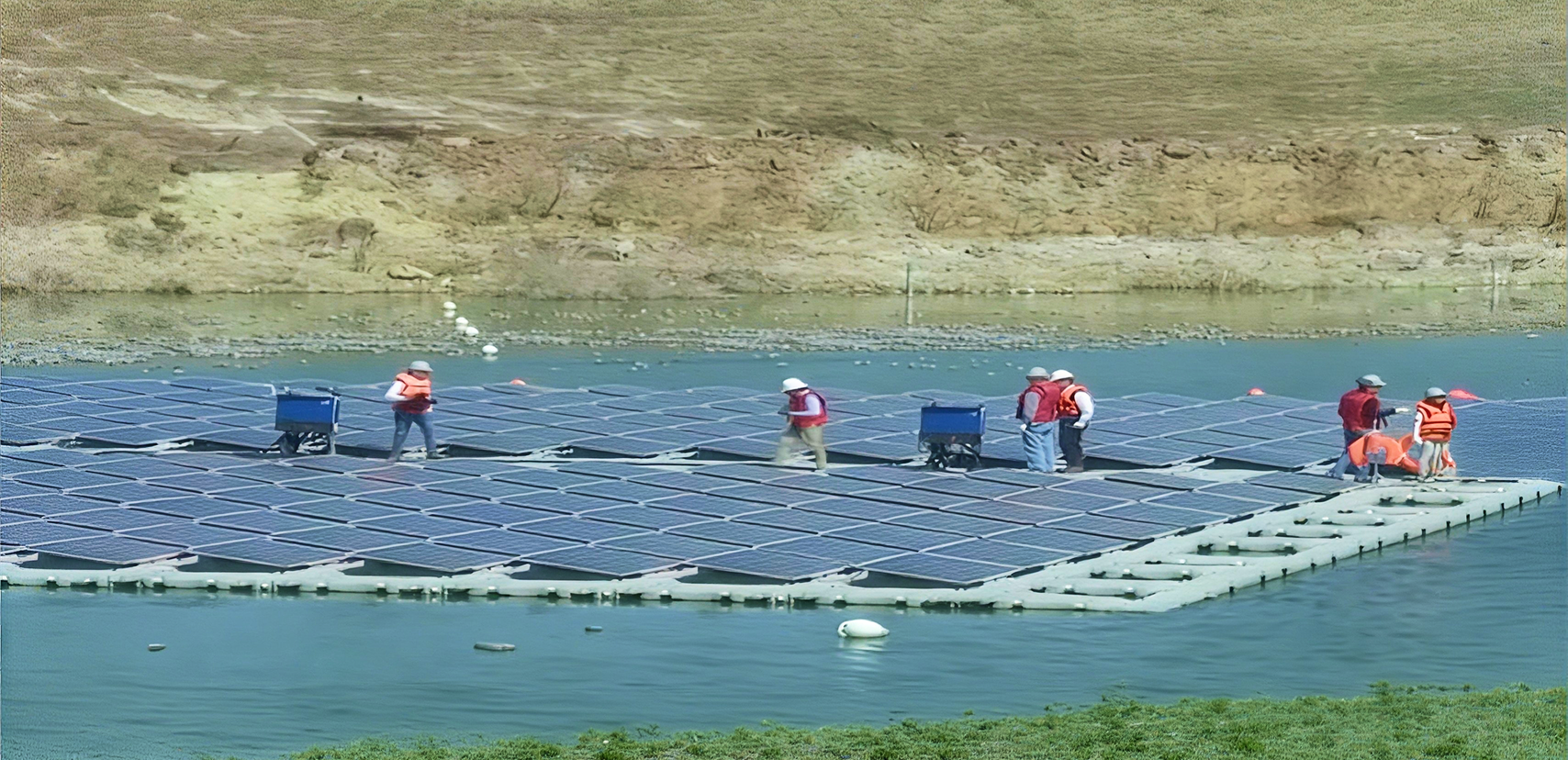 Floating solar panels generate clean energy on water surfaces
For all its advantages, floating solar has historically carried an obvious disadvantage: higher upfront cost.
According to Mr. Sanjay Banga, setting up a typical ground-mounted solar project costs around ₹3.5 crore to ₹4 crore per MW. A floating solar project can cost approximately ₹1 crore per MW more.
At utility scale, that difference matters.
But the policy environment can change the commercial equation. Mr. Sanjay Banga described the government’s new scheme as a “very, very positive step”, arguing that it could bring floating solar costs much closer to those of ground-mounted projects.
That could prove important for the market.
If the cost disadvantage narrows while floating solar retains its advantages around land, execution, evaporation, and energy yield, developers are no longer evaluating floating solar merely as a specialized renewable technology. They can begin comparing it with ground-mounted solar on much more competitive terms.
As Mr. Sanjay Banga put it - “So, this will make virtually the ground-mounted solar and the floating solar cost virtually the same. And this is how it will promote more and more floating solar projects in India.”
This could be the inflection point floating solar needs. India already has the potential. Improving project economics could help convert a part of that theoretical opportunity into actual capacity.
Commercial competitiveness does not mean every floating solar project will look the same.
Water bodies differ significantly in depth, wave intensity, and physical conditions. Tata Power Renewable Energy’s experience at Kayamkulam and Omkareshwar demonstrates how those differences shape project design.
At the 101.6 MW Kayamkulam project, water depths are considerably shallower than at Omkareshwar
Those differences directly influence project design.
These conditions influence engineering as well as capital expenditure. Depending on factors such as depth and wave intensity, project costs can vary by around 25% to 35%. Stronger waves can also require additional measures such as wave barriers, which can add another 5% to 10%.
Yet Mr. Sanjay Banga’s larger point is important: site-specific does not necessarily mean prohibitively complex.
Engineering has to respond to the characteristics of each water body, but those differences can be addressed through the appropriate design choices. The challenge for scale is therefore not to make every reservoir identical. It is to build the capability to assess different conditions and engineer for them consistently.
In floating solar, the water body is not simply where the project sits. It becomes part of the engineering brief.
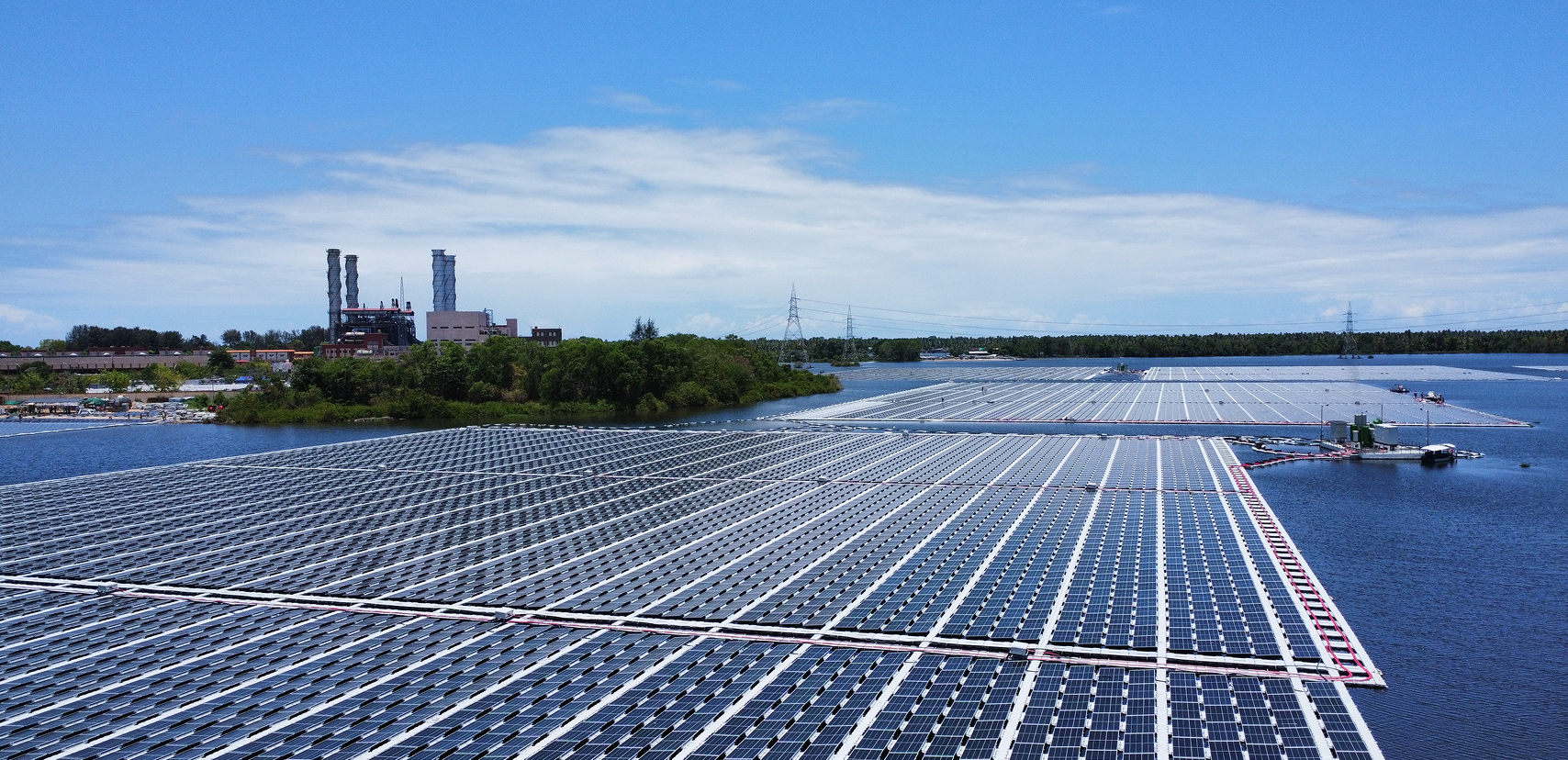 Tata Power’s 101.6 MWp floating solar project in Kayamkulam.
Another perception surrounding floating solar is that putting generation infrastructure on water must inevitably make it substantially more expensive to operate and maintain.
Experience suggests a more nuanced picture.
Ground-mounted solar requires expenditure on security arrangements and has its own operating requirements. Floating projects reduced some of those needs. Cleaning frequency can also be lower.
Where floating solar differs is in the skills required to maintain it. Personnel working on floating installations often require additional water-safety training and site-specific operational skills, creating a specialized workforce requirement that does not exist in quite the same way for conventional solar plants.
Condition-based monitoring can help manage that complexity by allowing maintenance frequency to respond to actual asset conditions.
Mr. Sanjay Banga explained -
“But if you have a good mechanism of a condition-based monitoring and then you are optimizing the frequency of maintenance on the basis of that, then I would say the operational cost for ground-mounted solar and the floating solar, the difference is not more than 10% as such.”
The question should not simply be whether one component of floating solar costs more. It should be whether the complete lifecycle economics remain competitive once differences in security, cleaning, maintenance, and specialized skills are considered together.
For an emerging renewable technology to grow rapidly, equipment availability and import dependence can become another potential bottleneck.
Here too, floating solar has an advantage: much of what it needs already exists within the broader solar ecosystem.
The solar modules used are the same as those deployed in ground-mounted projects. The floats that create the platform can be manufactured by Indian manufacturers and developed at the project site. Design expertise and consulting capability are also available within India.
There are specific areas where imported components may still be necessary. Specialized mooring arrangements, for instance, can require imported ropes where wave conditions demand them.
But floating solar does not require India to create an entirely new technology ecosystem before projects can scale.
That distinction could become increasingly important. Scaling becomes considerably easier when an emerging application can build on capabilities the industry already possesses rather than waiting for a completely new supply chain to develop around it.
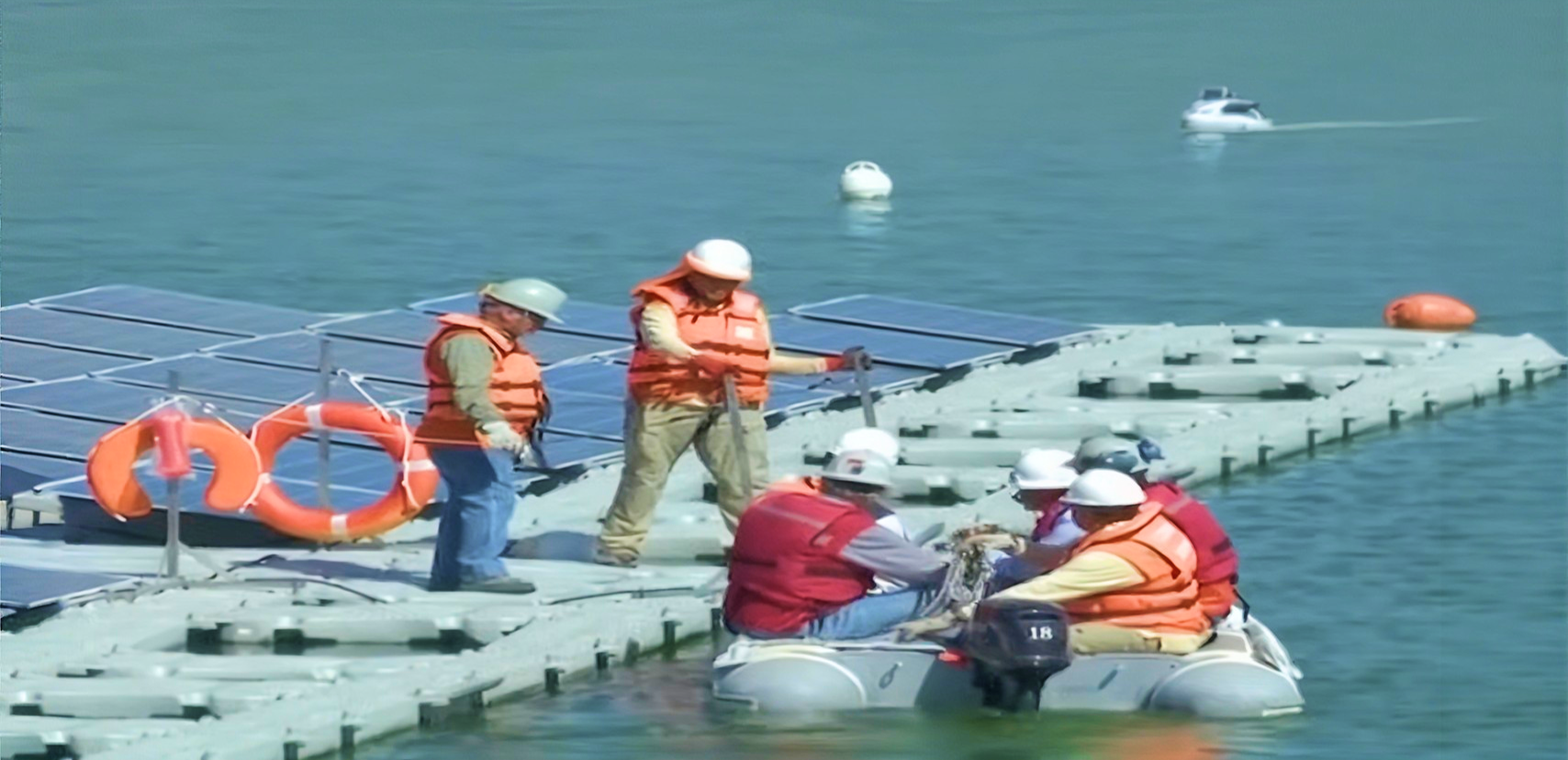 Floating solar builds on India’s existing solar manufacturing ecosystem
The opportunity is already moving beyond theory.
Around 200 MW of Tata Power Renewable Energy’s 7 GW portfolio is currently in floating solar. The company has also taken around 2,500 acres of reservoir where the Odisha government wants to develop floating solar projects, representing an additional opportunity of around 500 MW.
For Mr. Sanjay Banga, this is not simply a Tata Power opportunity. The policy environment could help developers across the sector participate more actively in floating solar.
Tata Power Renewable Energy itself intends to remain active as new opportunities emerge.
What makes that significant is the shift in the nature of the conversation. Floating solar is no longer being discussed only in terms of whether the technology works. The questions are increasingly about how quickly projects can be executed, how their economics compare with ground-mounted solar, and how effectively available water surfaces can be brought into India’s renewable energy landscape.
That is the transition from experimentation to scale.
Any expansion of infrastructure on water bodies will naturally bring questions about its interaction with the surrounding environment.
Concerns have been raised about sunlight reaching the water, aquatic ecosystems, and communities dependent on water bodies. Mr. Sanjay Banga’s view is that the benefits of floating solar, particularly reduced evaporation, must also form part of that assessment.
He also points to the national assessment of floating solar potential, which evaluated technical suitability across eligible water bodies, while recognizing that project-specific environmental assessments remain important.
That broader perspective matters because the case for floating solar should not rest on capacity alone.
The technology becomes truly valuable when water, energy, and land can be considered together rather than as competing resources. Reduced evaporation, productive use of suitable water surfaces, and renewable generation can form part of the same infrastructure proposition, provided environmental considerations are addressed appropriately.
That is a much more meaningful way to evaluate floating solar than simply asking how many panels can fit on a reservoir.
The scale of India’s floating solar opportunity is already clear. The next question is not how much water can host solar, but how much of that opportunity can stand up to the discipline of real projects.
That is where the sector will be tested: in-site selection, engineering choices, and operating performance that hold up across very different water conditions. The next phase will belong to projects that make this complexity manageable, not invisible.
The real opportunity is therefore not merely to put solar panels on water. It is to rethink where renewable infrastructure can be built, how efficiently existing surfaces can be used, and how India can unlock more clean-energy capacity without making land the only place where its solar ambitions have to grow.
Keep reading...
View all