


 Contact us
When learning becomes more accessible, capability follows


Introduction
India's skill gap isn't just about graduates and jobs. It shows up hardest among the frontline workers who keep essential services running, often out of sight and out of reach of formal training systems. Most training models still assume the worker will come to the learning. For a workforce this large and this spread out, that assumption is the problem, not the solution.
The scale of the problem is easy to underestimate until you look at it directly. India faces a projected shortfall of 47 to 49 million skilled workers by 2027, according to estimates from the National Skill Development Corporation and the World Economic Forum, cited in the Wheebox ETS India Skills Report 2025. 82% of employers surveyed for that report said they struggle to find candidates with the right skills, and nearly 92% of Indian adolescents have had no formal skill training exposure at all before entering the workforce. These numbers describe job-seekers broadly, but they understate the problem for a specific slice of the workforce: the technicians, linemen, and field staff who keep power, rail, and logistics networks running, many of whom have learned their trade informally, from whoever trained before them, rather than through any structured system.
That informality persists for a structural reason, not a lack of intent. Classroom training pulls staff away from live operations for a full day once travel is factored in; supervisors, who are accountable for any delay in service, are reluctant to release them; and even where digital platforms exist, patchy connectivity and low device access blunt their reach. Global research on frontline and deskless work supports the scale of what's at stake: this segment makes up the overwhelming majority of the world's workforce, and the market for training it was already worth an estimated $25 billion in 2024, projected to reach $88 billion by 2032. That is not a niche concern. It is a structural shift that every dispersed, field-heavy industry will eventually have to plan around, and it starts with a question most training strategies never think to ask: what if the worker was never the one who was supposed to travel?

What are Indian organisations already doing about it?
Some organisations are already answering that question in practice, and the answers differ mainly in what they treat as the real constraint. For a workforce this dispersed, the honest starting point is usually a leadership call rather than a training redesign: a decision to invest in reach and repetition, even when both are harder to plan and measure than a one-off classroom session.
Indian Railways has approached this at massive scale through Mission Rail Karmayogi, which set out to train about one lakh frontline staff within six months through a cascade of trainers reaching staff wherever they were posted. More recently, South East Central Railway introduced Sanraksha, a mobile application built to deliver safety and capacity-building training to frontline staff on demand. Both are genuine, large-scale attempts to solve the same last-mile problem, and both work well where connectivity, devices, and digital fluency are already in place. In geographies where any of those three are missing, which is common for linemen and field technicians working in remote terrain, the same models leave a gap that needs a different kind of solution.
Tata Power's Odisha operations took a more literal route: if the constraint was distance, the answer was to remove it, not work around it. Training on Wheels takes the classroom itself to the worker's doorstep across Odisha's power distribution network, run through the four Odisha Discoms, TPNODL, TPCODL, TPSODL and TPWODL. A mobile unit reaches clusters of field offices directly, delivering short, focused sessions on-site rather than pulling staff away for a full day. In six months, nearly 7,000 employees have been trained across more than 900 field locations across the state, a scale that would have taken years to reach through centralised training given the geography involved. What matters here is not the vehicle. It is the underlying decision to treat proximity, not connectivity or infrastructure, as the constraint actually worth solving for.
What impact is this having on the people being trained?
For the linemen and helpers being trained, this is turning out to mean something closer to being seen than simply being taught. Many of these employees have spent years learning informally, with skills and safety habits passed down from a senior colleague who may themselves have had no structured training, a pattern common enough across the power sector that the Central Electricity Authority built an entire national platform, Lineman Diwas, around recognising it. This year's edition carried the theme "Seva, Suraksha, Swabhimaan," meaning service, safety, and dignity, a framing that captures something training programmes rarely account for: that showing up at someone's workplace, rather than asking them to travel to yours, is itself a statement about whether their time and safety matter. Structured, repeatable training doesn't just build capability. It signals, for perhaps the first time for some of these employees, that their growth is being actively invested in rather than left to chance.
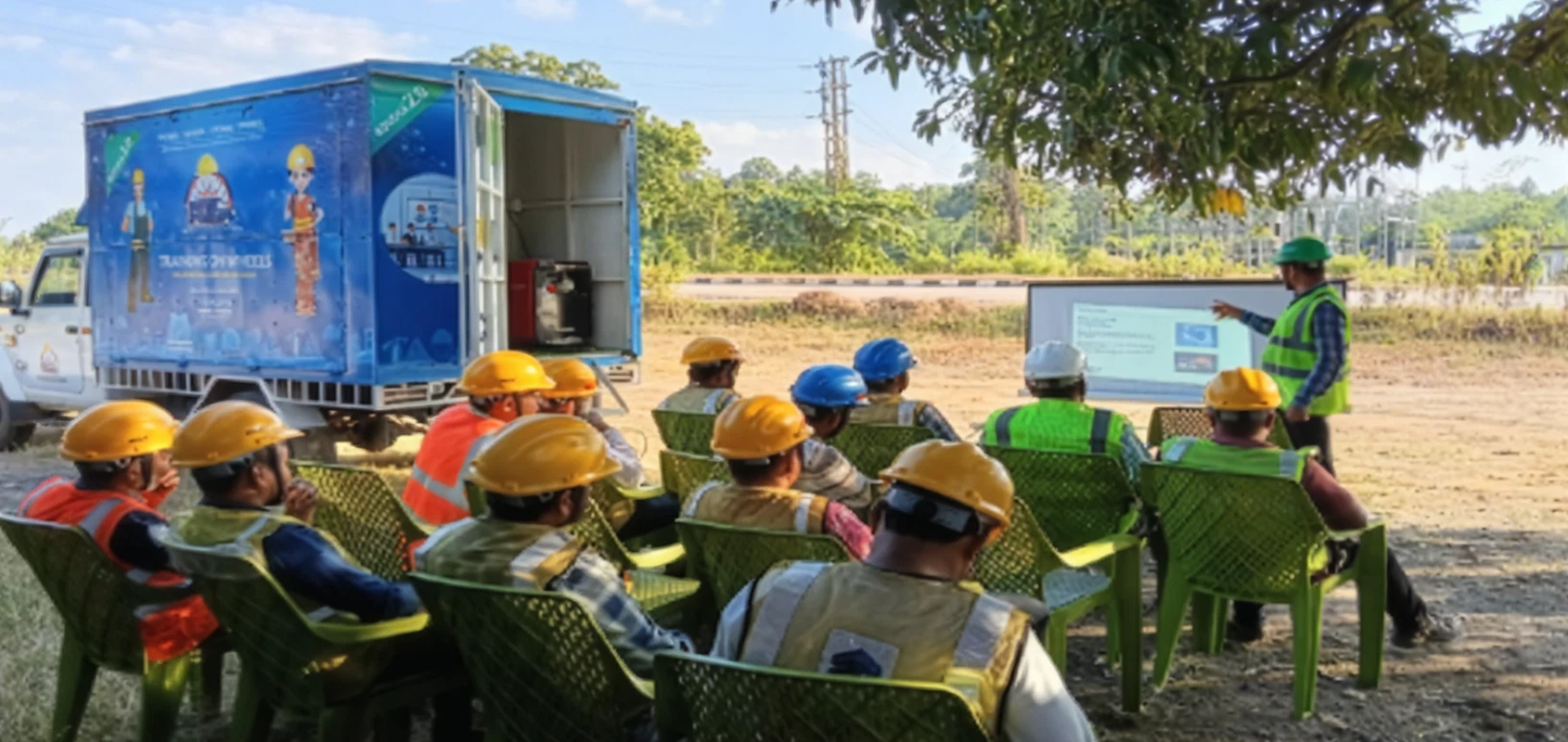
Training on Wheels brings learning closer to the people who keep the power on
Why is this a values story, not just a training programme?
This is a values story because the model was shaped as much by partnership and principle as by logistics. Tata Power's Odisha operations run through a Public-Private Partnership with the Government of Odisha and the Odisha Electricity Regulatory Commission, and that partnership matters here for more than one reason. It means Training on Wheels does not exist purely as an internal L&D initiative; it operates inside a regulated public utility mandate, answerable to public institutions responsible for reliable power delivery across the state. That context has also helped position Tata Power's Odisha Discoms as a benchmark for how public infrastructure and private execution can work together at scale, and it gives an initiative like this a level of accountability that a purely internal programme would not carry. Training on Wheels sits naturally inside that mandate: reinforcing standard operating procedures and a "First Time Right" approach isn't only about efficiency, it's a direct expression of safety and care, two of the five values (Safety, Care, Agility, Learning, Ethics) that Tata Power describes as its operating philosophy. Seen this way, the mobile classroom isn't a clever workaround. It's what those values, and that partnership, look like when applied to the hardest-to-reach part of the workforce.
What does this mean for the future of frontline learning?
The organisations built to last will be the ones willing to redesign how learning reaches people, not just what it teaches them. Tata Power's own ambition for Training on Wheels is to eventually reach every office across its Odisha Discoms, a modest-sounding goal that, given the geography involved, is genuinely ambitious. But the wider lesson extends well beyond one company or one state. India's frontline workforce, in power, rail, logistics, and beyond, is large, essential, and still largely outside the reach of formal skilling systems, and closing that gap will depend less on how sophisticated a platform is than on a willingness to act on a simple premise early.
The last mile of India's workforce, the linemen, the field technicians, the people keeping essential services running from places most training systems were never built to reach, has waited long enough at the margins of this conversation. Training on Wheels is one answer, grounded in one state's geography and one company's values, but the principle behind it belongs to every sector wrestling with the same distance between its people and its capability-building systems. The real marker of progress will not be how advanced the training becomes. It will be how far it is willing to travel to meet the people who need it most.
Sources
- India Skills Report 2025, Wheebox ETS
- Josh Bersin Company Highlights Cost of Neglecting Frontline Workers, PR Newswire
- Over 51,000 Frontline Railway Staff Trained Under Mission Rail Karmayogi, Press Information Bureau, Government of India
- Railways Introduces Sanraksha App for Frontline Staff, ThePrint
- Central Electricity Authority Recognizes Power Sector Frontline Workforce at 6th Lineman Diwas, PV Magazine India
- Odisha Discoms Launch AR/VR 'Training on Wheels' for Field Staff, Pragativadi
Keep reading...
View all