


 Contact us
Tata Power brings India’s largest floating solar power project to Kerala backwaters


Lighting the path to nationwide sustainability: Kerala
Tata Power brings India’s largest floating solar power project to Kerala backwaters
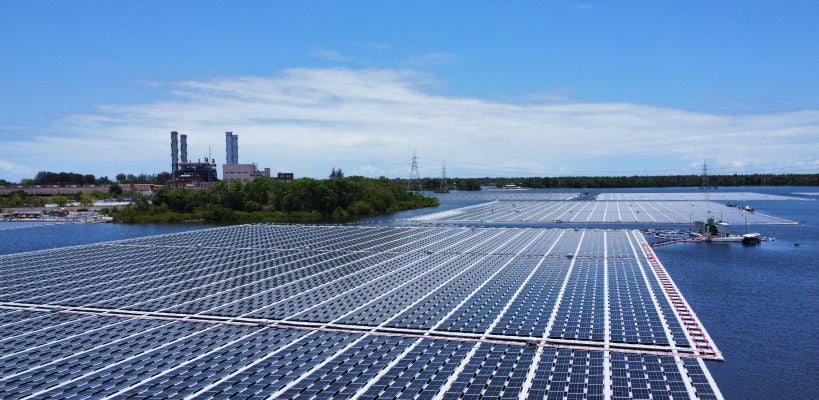
In a bid to push India's sustainable journey forward with innovative technology, Tata Power Solar unveils a 101.6 MWp floating solar project in the glistening backwaters in just 19 months.
The solar power project has established a significant milestone for Tata Power. This innovative endeavor creatively utilizes 350 acres of previously unused water body surface area. It's projected to generate a substantial 167,150 MWh of clean energy annually and significantly reduce carbon emissions by an impressive 64,142 tonnes. This landmark project not only demonstrates the efficient use of unused space but also sets a record for the fastest large-scale floating solar project completion, securing its Commercial Operation Date (CoD) certification on June 24th, 2022.
PROJECT SIZE: 101.6 MWP
PROJECT TYPE: FLOATING SOLAR PV
PROJECT COMPLETION TIME: 19 MONTH
LAND AREA: 350-ACRE WATER BODY
NO. OF MODULES: 2,05,497
ANNUAL ENERGY YIELD: 1,67,150 MWH
CO2 OFFSET: 1,42,077 TONNES PER YEAR
SAFE MAN HOURS: 10,20,488
This landmark had CCTV monitors 24x7 for airtight security and malfunction identification. Not to forget, this floating setup operates through 2,05,497 modules and it is the first time at Tata Power that a floating inverter platform carries a 5 MW capacity.
As per the power purchase agreement signed with a PSU client, the entire power generated from this plant will be used by the Kerela State Electricity Board (KSEB). While this roaring success makes us believe that we’re drawing closer to India’s sustainability goals for 2030, it did not come without challenges.
To complete the project, the entire line-up including floats and solar panel modules had to be towed for 3 kilometers on a sea-linked National waterway. But strong winds and gushing tides reaching up to 3.5 meters buffeted the solar modules during their 3-kilometer tow across the 15-meter deep, sea-linked National waterway. Hence, to bring the project to completion, the team had to bring together 33/220 Kilovolts Air Insulated Substation (AIS) with 220 Kilovolts of existing Gas Insulated Substation (GIS). But this is not the only major inconvenience, below are a few more hurdles faced by the team:
134 cast pile foundations were painstakingly established to build the scaffolding platform upon which rests the entire solar plant
Dredging of soil strata underwater up to 20 meters depth was not the only problem that TPSSL faced; they also had to brave the heavy monsoon to set up the Central Monitoring and Control Stations (CMCS) and the 33/220 kilovolts switchyard
The installation also presented unique challenges due to low water levels, which delayed mooring placement
The project also encountered challenges related to local fishermen's activities, including encroachment, theft of materials, blocked walkways due to fishing nets, and damage to built-in structures
The high-water salinity was also a crude interrupter to the team’s work
To create a better tomorrow for all generations, Tata Power left no stone unturned. A shining example is how they not only safely completed the project, but also carried, unloaded, and stored all the solar modules for 35 days on a small plot of land. When the team was alerted about the urgency of contract agreements, a 350-person team was consolidated to accelerate and accomplish the project within 10,20,488 safe man hours.
Once the project was closed, the company touched a new milestone in having executed utility-scale solar projects totaling 9.7 GWp.
Keep reading...
View all