


 Contact us
Difference between CAPEX and OPEX solar? It’s ownership vs flexibility


Introduction
With India’s solar capacity crossing 143 GW, including nearly 25 GW from rooftop installations, the shift to rooftop solar is becoming a strategic move rather than just an operational upgrade. As companies increasingly evaluate CAPEX vs OPEX solar models, the conversation is no longer about adopting solar, but about structuring it in the most effective way to manage costs and long-term value.
The real advantage lies not in going solar, but in choosing how you invest in it.
You might think choosing between CAPEX and OPEX solar is just a financial decision. But it goes much deeper. One model builds ownership and long-term value, while the other focuses on flexibility and ease. What truly matters is how each approach shapes costs, control, and long-term outcomes. So, before settling on a model, let’s break down what each approach really offers.
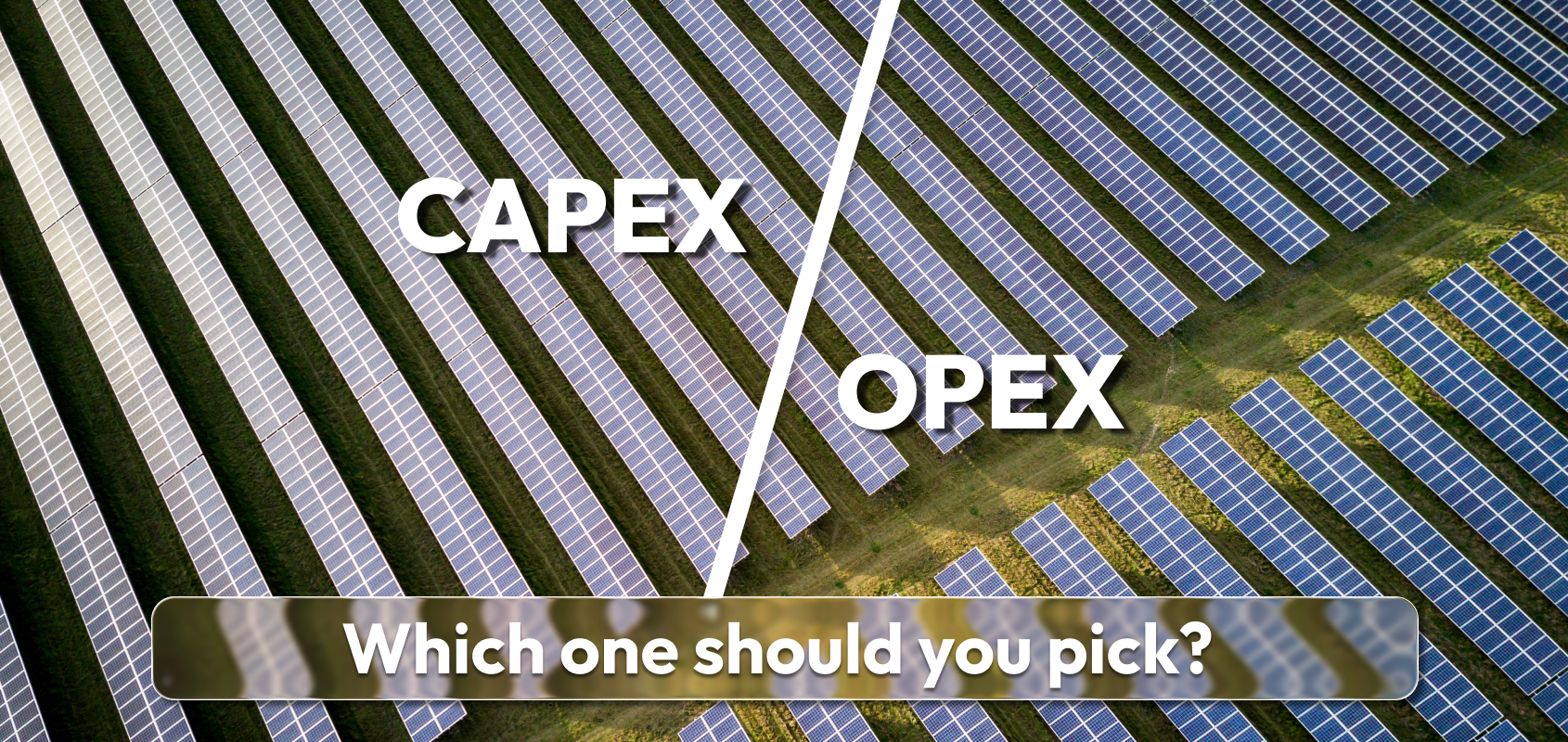
What is the difference between the CAPEX and OPEX solar model?
While both CAPEX and OPEX models enable solar adoption, they differ fundamentally in how the investment is structured and managed. Understanding these differences is essential to evaluating their impact on cost, control, and long-term value.
| Parameter | CAPEX solar model | OPEX solar model |
|---|---|---|
| Ownership structure | The business owns the solar asset, enabling complete control over performance, lifecycle, and upgrades | The solar asset is owned by a third-party developer, with the business acting as a power consumer |
| Investment approach | Requires upfront capital investment or financing to set up the system | No upfront investment; costs are spread over time through energy payments (per-unit charges) |
| Cost structure | High initial cost followed by significantly reduced electricity expenses over time | Fixed or slightly escalating tariff under PPA (Power purchase agreement). Savings exist but are capped. |
| Savings profile | Higher cumulative savings over the solar system’s lifespan due to ownership | Immediate but comparatively moderate savings due to ongoing payments |
| Operations and maintenance | Managed by the business, typically through service (AMC) contracts | Fully managed by the developer, reducing operational burden |
| Financial treatment | Considered a capital asset, improves long-term ROI and reflects on the balance sheet | Treated as an operational expense with no asset ownership |
| Tax benefits | Eligible for accelerated depreciation and incentives | Benefits typically accrue to the developer, not the consumer |
| Risk allocation | Performance and operational risks remain with the owner | Performance, maintenance, and operational risks are handled by the developer |
| Strategic flexibility | High flexibility to upgrade, expand, or integrate new technologies | Flexibility depends on contractual terms and agreement duration |
The difference between the CAPEX and OPEX solar model ultimately comes down to ownership versus service. One builds an asset. The other delivers convenience. Looking to go beyond CAPEX vs OPEX solar models and understand solar energy’s real impact? Explore more
CAPEX vs OPEX: Can you crack it?
Choose correct statement.
Bottomline
The real value of CAPEX and OPEX solar models lies in choosing a structure that matches how a business wants to grow. Solar is no longer just about lowering bills. It is about deciding whether energy should be treated as an owned asset, a managed service, or a strategic lever for future stability. The right model depends on capital strategy, operational bandwidth, and long-term vision. For businesses ready to think beyond short-term savings, solar offers more than clean power. It creates a stronger, more resilient way to manage costs, plan ahead, and build lasting value.

Move forward with a complete solar solution by our experts
Frequently asked questions
The frequently asked questions section is a reliable source for unlocking answers to some of the most crucial inquiries. Please refer to this section for any queries you may have.
- FAQ
Yes, many large Indian businesses adopt a hybrid approach. They use CAPEX for owned facilities where long-term savings matter and OPEX for leased or new locations. This balances capital efficiency with cost optimization and is increasingly common in multi-location operations.
There is no single “better” model between CAPEX and OPEX solar in India. The right choice depends on business priorities. CAPEX is preferred for long-term savings, ownership, and tax benefits, while OPEX suits businesses seeking zero upfront investment and hassle-free operations. Both models can reduce energy costs effectively, but the decision should be based on capital availability, risk appetite, and long-term strategy.
The payback period for a CAPEX solar model in India typically ranges between 3 to 5 years for commercial installations and around 4 to 7 years depending on system size, electricity tariffs, and location. According to Tata Power Solar, many rooftop systems achieve payback within this range, after which businesses benefit from significantly reduced electricity costs over the system’s lifecycle.
Government incentives in India, such as those under the Ministry of New and Renewable Energy, are typically linked to system ownership. This means CAPEX models are more likely to qualify for benefits like subsidies or accelerated depreciation. In OPEX, the developer owns the system, so most financial incentives are claimed by them, not the consuming business.
Financing availability plays a key role in CAPEX adoption by reducing the burden of upfront investment. Tata Power enables this through structured financing options such as loans with fixed tenures, EMIs, and collateral-free schemes, allowing businesses to own solar systems while spreading costs over time. This makes CAPEX more accessible and improves long-term returns without straining cash flow.
Yes. OPEX solar operates through a Power purchase agreement (PPA), which is a legally binding contract between the business and the developer. These agreements typically define tariff, tenure, performance guarantees, and exit conditions. Since PPAs can run for 10–25 years, businesses must carefully review terms related to escalation, termination, and system ownership at contract end.
Yes. Rooftop availability and usable area directly impact system size and feasibility. Developers under OPEX models typically prefer larger rooftops with consistent energy demand to ensure viable returns. Smaller rooftops or fragmented spaces may limit OPEX feasibility, making CAPEX a more practical option for businesses that still want to adopt solar.
Net metering allows businesses to export excess solar power to the grid and receive credits on their electricity bills. It improves the financial viability of solar projects, especially under CAPEX models, by maximizing utilization of generated power and reducing wastage. Policies vary by state, but it remains a key enabler of rooftop solar adoption.
Many MSMEs face barriers such as limited access to financing, lack of awareness about solar business models, and concerns around asset quality and maintenance. Studies supported by institutions like the World Bank and SBI highlight that upfront investment, and perceived risks often delay adoption, even when long-term savings are clear.
Electricity can account for a significant share of operating costs for Indian businesses, especially MSMEs. Rooftop solar helps reduce dependence on DISCOM power, leading to lower energy bills and protection against tariff increases. This makes solar not just an energy solution, but a cost optimization strategy.
Sources
1. Affordable solar financing in India for homes & businesses
2. Pradhan Mantri Kisan Urja Suraksha evam Utthaan Mahabhiyaan (PM KUSUM)
3. Identifying barriers for rooftop solar uptake in MSMEs and development of a mitigating financial framework
4. Schemes - MNRE
5. Affordable solar financing in India for homes & businesses
6. Tata Power Marks Major Milestone with 1.5 Lakh+ Rooftop Solar Installations, 3 GW Capacity; Expands Footprint across 700+ Cities
7. OPEX vs CAPEX in India: Key Solar Financing Differences
8. OPEX/CAPEX/PPA
9. Solar CAPEX Model//Solar Financial Model//Highlights of CAPEX Model
Keep reading...
View all