

 Contact us
| Factor | Ethanol / Flex-fuel car | EV |
|---|---|---|
| Energy source | Ethanol-petrol blend (E20, and E85 for flex-fuel) | Grid electricity in a battery |
| Powertrain | Modified combustion engine | Battery and electric motor |
| Upfront cost | Small premium over the petrol version | Often higher than comparable ICE cars |
| Running cost | Depends on blend, price and mileage | Usually lowest with home charging |
| Maintenance | Familiar engine servicing | Fewer moving parts |
| Tailpipe emissions | Yes, at lower carbon intensity | None |
| Range | Long, refuel in minutes | Model-dependent, so plan longer trips |
| Refuelling / charging | Fuel pump | Home, workplace or public charger |
| Infrastructure | Existing fuel network, E85 very limited | Growing but uneven |
| Long-distance travel | Familiar refuelling, E85 limited to select areas | Workable on covered corridors |
| Driving feel | Familiar engine | Quiet, smooth, instant response |
| Home dependency | Low. Can rely on fuel stations | Higher if home charging is the main charging option |
| Energy efficiency | Lower. Combustion engines lose more energy as heat | Higher. Electric motors use energy more efficiently |
| Vehicle availability | E20-compatible cars are widely available. Flex-fuel models are limited | Growing range of models across segments |


Introduction
Ethanol and EVs are two different routes away from conventional petrol in India. As the government pushes higher ethanol blends, E20-compatible and flex-fuel cars keep the engine and change the fuel, while EVs replace it with a battery and motor. Let's uncover how they compare on cost, emissions, range, charging and maintenance, and which one fits the way you drive.
That push is now visible at the pump. In June 2026, the Press Information Bureau announced the rollout of E85, a high-ethanol fuel for flex-fuel vehicles, at 48 public-sector outlets, to be scaled to 500 by December 2026 and about 5,000 by December 2027. On the electric side, Business Standard reports that registered EVs have crossed 10 million, though four-wheeler penetration is still 5.70%. So which route should your next car take?
What is an ethanol vehicle?
An ethanol vehicle is a vehicle that runs on petrol blended with ethanol, with flex-fuel vehicles designed to use much higher ethanol blends such as E85. In India, it is important to distinguish between an E20-compatible car, which is designed to run on the E20 petrol now available, and a flex-fuel vehicle, which can adapt to a wider range of ethanol-petrol blends.
- Ethanol-blended petrol: This is petrol with ethanol mixed in. Ethanol is an alcohol made mainly from crops such as sugarcane, maize and rice. E20 means 20% ethanol, a level India reached in 2025, five years ahead of the original 2030 target.
- An E20-compatible car: This is an ordinary petrol car built and tested for E20 fuel. It uses ethanol only because the pump supplies it, and its hardware isn't designed for much higher blends.
- A flex-fuel vehicle (FFV): This is engineered to run on a wide range of ethanol-petrol mixes, up to E85. It carries changes to the fuel system, injectors, fuel lines, ECU calibration and ethanol sensors.
The difference between an E20-compatible car and a flex-fuel car is simple. An E20-compatible car is built for one blend, and a flex-fuel car is built to adapt across many. E85 is meant only for specially designed and certified flex-fuel vehicles, not regular petrol cars.
What is an electric vehicle?
An electric vehicle (EV) is a vehicle powered by electricity stored in a battery, which drives an electric motor instead of an internal-combustion engine. A battery electric vehicle has no engine, fuel tank or exhaust, and regenerative braking can send some energy back to the battery.
The practical change is how you "refuel". You plug in, usually at home overnight, and use public chargers when travelling.
Ethanol car or EV in India: Which to buy in 2026?
An EV can be the more suitable choice for drivers with reliable charging access, especially for regular city use, while an E20-compatible or flex-fuel car can suit drivers who depend on fuel stations or frequently travel routes with limited charging. The right choice depends on running costs, upfront price, range, charging or refuelling access, maintenance and everyday driving needs.
1. Ethanol vs EV: Cost and running expenses
Purchase price
Flex-fuel cars cost more than their petrol equivalents. EVs typically cost more upfront than comparable ICE cars, though the size of the gap varies widely by model.
Running cost
An exact ethanol-vs-EV figure can't be stated honestly, because it depends on the ethanol blend, fuel price, the engine's efficiency, your electricity tariff, whether you charge at home or in public, and how far you drive each year. What can be said is where the pressure points are.
- Ethanol carries less energy per litre: Industry executives have said E85 would need to be at least 30% cheaper than conventional petrol to make economic sense, since ethanol holds roughly one-third less energy.
- E85 is cheaper per litre, but not by that much: In Delhi, E85 launched at ₹82.12 per litre, ₹20 below E20. That's around a 20% discount. Published estimates suggest mileage on E85 could be 25–35% lower than on E20.
- EV costs depend heavily on where you charge: Industry estimates put home tariffs at roughly ₹4–10 per unit, against ₹15–25 per unit at public DC fast chargers.
For example: Take a car returning 15 km/L on E20 at ₹102.12/L, roughly ₹6.80 per km. On E85 at ₹82.12/L with the 25–35% mileage drop above, that becomes roughly ₹7.30–₹8.40 per km. An EV using 6–7 km per unit costs roughly ₹1–1.50 per km at home tariffs and about ₹2–4 per km on public fast chargers. Real-world E85 testing is still limited, so treat these as rough ranges and rerun them with your own numbers.
- Maintenance and ownership: EVs have fewer moving parts and generally need less routine servicing. EVs have lower running and maintenance costs. That makes annual kilometres a key variable. The more you drive, the more an EV's low per-km cost matters.
2. Ethanol vs EV: Environmental impact
Neither pathway is "completely green". The picture splits into four parts.
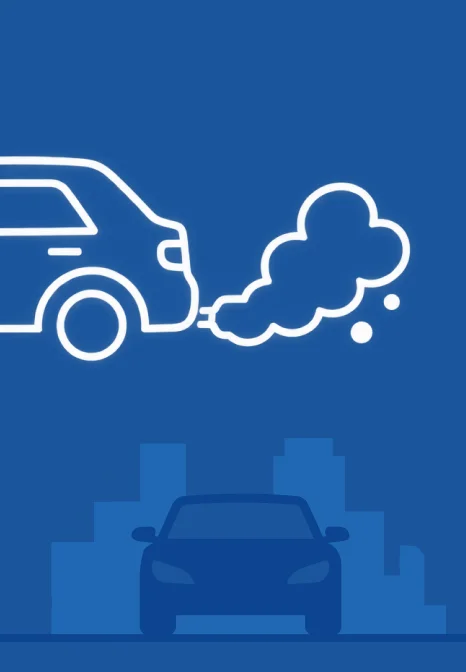
EVs have none. Ethanol cars still produce them, though the fuel is less carbon-intensive. The petroleum ministry says E20 cuts carbon emissions by roughly 30% compared with E10. This is an official claim, and lifecycle assessments give a more varied picture
Tailpipe emissions
EV emissions depend on how the electricity is generated and on battery manufacturing. One Indian life-cycle assessment found that EVs had lower carbon emissions than fossil-fuelled light vehicles across segments, but performed worse on 16 other environmental categories, linked to the 72.6% coal share in the grid. A cleaner grid should improve this over time
Electricity and batteries (for EVs)
An Indian life-cycle study of ethanol-gasoline blends notes that ethanol production can rely on fossil-fuel-derived energy, such as steam for distillation. Farming ethanol crops also involves land, water and fertiliser use
Feedstock and production (for ethanol)

Zero tailpipe emissions matter most in dense cities, which is where EVs offer the clearest advantage
Local air quality

The fair summary is that EVs eliminate tailpipe emissions and their footprint improves as the grid decarbonises. Ethanol lowers the carbon intensity of the fuel while keeping the engine, and its benefit depends on how and from what the ethanol is made.
3. Ethanol vs EV: Performance and driving experience
EVs deliver power instantly and quietly: City driving feels effortless, with no gear changes and little vibration.
Ethanol cars feel like the petrol cars you know: Ethanol has a higher octane rating (about 108.5 versus 84.4 for petrol, according to the government), which can influence performance. But the effect depends on engine design and calibration, so real-world behaviour is model-dependent. Don't assume a universal gain.
4. Ethanol vs EV: Range, refuelling and charging
Refuelling an ethanol or flex-fuel car takes minutes and an E20-compatible car uses the same pumps you already use. E85 is a different story. It launched at 48 outlets, with government plans for 500 by December 2026 and 5,000 by end-2027. Those are targets. For now, dispensing points are limited to select areas around Delhi-NCR and the Mumbai–Nagpur corridor.
Charging an EV takes longer, but can fit around your day: At home, a standard 15A socket can take 8–10+ hours for a full charge, while a dedicated home charger is faster. Public fast chargers can add substantial range in 30 minutes to an hour, depending on the charger and battery.
India's charging network is growing but uneven: India had 52,718 public charging stations as of 31 March 2026, roughly one for every 190 EVs. About 73% of chargers are rated below 30 kW. That suits city top-ups, while long highway trips need more planning. As charging becomes part of everyday EV ownership, knowing how different charging options work can help you plan around your driving needs.

5. Ethanol vs EV: Maintenance and everyday practicality
EVs need less routine servicing, with no engine oil, spark plugs or exhaust system. Battery health and software are the new things to monitor.
Ethanol and flex-fuel cars use familiar mechanicals, serviceable at any workshop. Some older petrol cars may need certain rubber parts and gaskets replaced earlier on E20, which the government describes as an inexpensive job during routine servicing.
Day to day, the deciding factor is routine. A fixed parking spot with power access suits an EV. Street parking, shared lots or frequent inter-city driving suit the pump-based model.
Ethanol car or EV: Which fits your driving needs?
The better fit between an ethanol vehicle and an EV depends on your access to charging or fuel, typical driving distance, regular routes, upfront budget and how you use your car. An EV can work well for drivers with dependable home or workplace charging, while an E20-compatible or flex-fuel car can be more practical where access to charging is limited or fuel stations better match the driver's routes.
Here is how they play out:
- City driving: An EV suits it best if you can charge at home or work. Short daily distances fit a plug-in routine, and the tailpipe benefit is greatest where air is worst.
- No home charging: An ethanol-compatible car is the easier choice. Depending on public chargers for every top-up is where EV ownership gets difficult.
- Long-distance travel: It depends on the route. An ethanol-compatible car is the simpler choice where charging coverage is thin or unknown. An EV works well on corridors with reliable fast charging, if you plan stops. A flex-fuel car gains no extra advantage unless E85 is sold on your route.
- Reducing petroleum use: An EV displaces petroleum entirely for that car's driving. A flex-fuel car on E85 displaces most of it per litre, but only where E85 is sold. An E20-compatible car displaces roughly a fifth by volume.
If you can charge reliably at home or work and drive mostly in the city, an EV is likely the better long-term buy. If you rely on fuel pumps, lack charging access or drive long routes, an ethanol-compatible or flex-fuel car still makes sense. Let your parking situation, typical distances and budget decide, not the technology label.
For buyers considering an EV, charging access is one of the most important practical factors to assess before making the switch. The next step is to look at where you can charge, how quickly you need to charge and what kind of setup your routine requires.
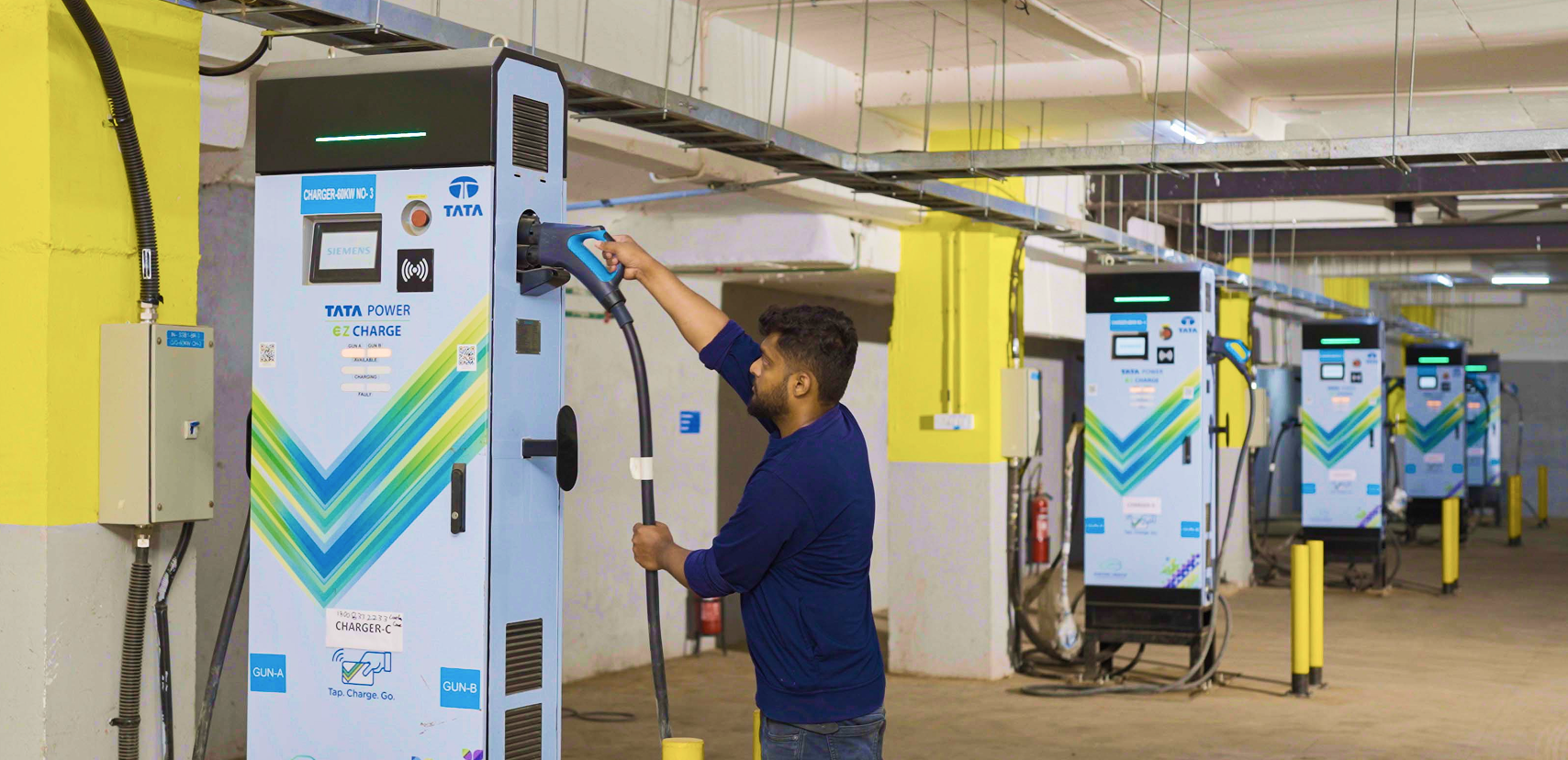
Tata Power EZ CHARGE serves homes, workplaces and highways
EV charging in India and where to get started
If an EV fits your driving needs, the next practical question is how and where you will charge it. Home, workplace, housing society and public charging can all play a role, depending on where you park, how far you drive and the routes you take. Tata Power EZ CHARGE brings these charging options together across different stages of an EV owner's journey.
- Home charging: Charger installation at your home, so you can plug in overnight.
- Housing societies and workplaces: Shared charging for residents and employees, useful if you can't charge at your own parking spot.
- Public charging: Charging points across cities for top-ups away from home.
- Highway fast charging: Fast chargers on highway routes, including the Delhi–Mumbai Expressway, for longer trips.
- One app: Find chargers and manage your sessions through the EZ CHARGE app.
- Expert guidance: Talk to the team about the right charger for your car and parking setup.
Charging speeds vary by charger and vehicle, so the right setup depends on your car, parking arrangement and typical usage. If you are considering home, workplace or shared charging, it helps to understand what will work for your specific needs.

Arrive at the one-stop destination for your charging needs
What is the future of ethanol and EVs in India?
Both ethanol and EVs are likely to remain part of India's transition towards cleaner mobility, but they are developing through different technologies, infrastructure and policy pathways. Ethanol is extending the use of existing combustion-engine vehicles through higher blends and flex-fuel technology, while EV adoption depends on vehicle availability, charging infrastructure and the electricity system.
Ethanol: Policy is still evolving. The government's current roadmap commits to E20 until 31 October 2026, with decisions beyond that date pending stakeholder consultation. On standards, BIS has notified specifications for E22, E25, E27 and E30, effective 15 May 2026. On the vehicle side, flex-fuel launches are only beginning.
EVs: Adoption is strongest in two- and three-wheelers, with four-wheelers still a small share. Charging is the constraint to watch. Government support includes ₹2,000 crore under PM E-DRIVE for public charging stations, including along highways.
A July 2026 analysis by Ipsos India describes the two as addressing different problems. In its view, flex fuels can be deployed quickly on existing infrastructure but still rely on combustion, while EVs need heavier investment but offer deeper long-term decarbonisation. Its conclusion is that a winner-takes-all outcome looks unlikely.
Bottomline
The real choice isn't ethanol versus electricity. It's between two different bets. One keeps today's habits and shifts the fuel, and the other changes the habit and shifts the energy source. Before you decide, look at where the car will be parked at night, how far you drive in a typical week, and which charging or fuelling options exist on your regular routes. Your answers will point to the right car far more reliably than any headline.
Frequently asked questions
The frequently asked questions section is a reliable source for unlocking answers to some of the most crucial inquiries. Please refer to this section for any queries you may have.
- Solaroof
Yes, an EV is generally cheaper to run than an ethanol car when it is charged mainly at home. Electricity used for home charging can cost less per kilometre than petrol or ethanol fuel, although the actual difference depends on the vehicle’s efficiency, electricity tariff, fuel price and charging mix. Public fast charging can narrow that gap because tariffs are typically higher than home charging
E85 can be cheaper per litre than petrol, but that does not necessarily make it cheaper per kilometre than charging an EV. E85 was launched in India at nearly ₹20 per litre below conventional E20 petrol, but its lower energy content means an FFV generally consumes more fuel for the same distance. An EV charged at home can therefore still have a lower running cost, depending on electricity and fuel prices and the efficiency of the two vehicles
No, E85 should not be used in a regular petrol car unless the vehicle is specifically designed and certified as a flex-fuel vehicle. E85 contains 80–85% ethanol and is intended for FFVs that can operate on a wide range of ethanol-petrol blends. An E20-compatible petrol car is not automatically an E85-compatible vehicle
E85 is currently available only at a limited number of fuel outlets in India, rather than across the regular petrol network. The rollout began at 48 public-sector OMC outlets in June 2026, with the government planning to expand this to 500 outlets by December 2026 and about 5,000 by December 2027. Availability should therefore be checked along your specific route before relying on E85 for regular travel
EV can be a more practical choice for city driving if you have reliable home or workplace charging. Shorter daily distances make overnight charging convenient, while regenerative braking and zero tailpipe emissions are additional characteristics of EV driving. An ethanol-compatible car can still be more convenient if you do not have dependable access to a charger.
For long-distance travel, the more practical choice depends on the routes you regularly take and the infrastructure available along them. An ethanol-compatible car can be simpler on routes with widespread fuel stations, while an EV can work well when your route has reliable, compatible fast-charging stops that you can plan in advance. E85 should not be treated as universally available because its rollout is still limited.
Yes, you can own an EV without home charging, but you need dependable alternatives such as workplace, housing-society or public charging. This is more practical when you have a predictable charging location near your home or workplace and suitable public chargers along your regular routes. India had 52,718 public charging stations as of 31 March 2026, while the broader charger count reached 67,657 as of 7 August 2026, including battery-swapping station chargers
No, E20 and a flex-fuel vehicle are not the same thing. E20 refers to petrol containing up to 20% ethanol, while a flex-fuel vehicle is specifically engineered to operate on a wider range of ethanol-petrol blends, including high blends such as E85. An E20-compatible car should therefore not be assumed to be capable of running on E85
EV charging can cost less per kilometre than ethanol fuel, particularly when the EV is charged at home. The comparison depends on electricity tariff, charging location, vehicle efficiency, ethanol blend and fuel price, so a lower price per litre for E85 does not automatically translate into a lower cost per kilometre. For a fair comparison, calculate the energy cost for the same distance using each vehicle's real-world efficiency
Sources
- E85 rollout commences across 48 retail outlets of Public Sector OMCs, PIB
- Response to Concerns on 20% Blending of Ethanol in Petrol and Beyond, PIB
- Ethanol Blended Petrol Programme – Q&A, PIB
- BIS IS 19850:2026 as reported by Autocar India, AUTOCAR India
- Are electric vehicles green? Sustainability assessment of light-duty vehicles in India, Springer
- Are ethanol-gasoline blends sustainable in India?, ScienceDirect
- E85 pricing and mileage estimates, DriveSpark
- Maruti Suzuki Wagon R Flex Fuel introduced in India, CarWale
- ICE vs EV: The Ethanol Question, CarWale
- Beyond EVs and Ethanol: Can India Balance Energy Security, Consumer Value and Sustainable Mobility?, AUTOCAR Professional
- Upcoming Flex Fuel Cars in India, MyCarJunction
Keep reading...
View all