


 Contact us
Group captive solar model balances ownership, scale and savings


Introduction
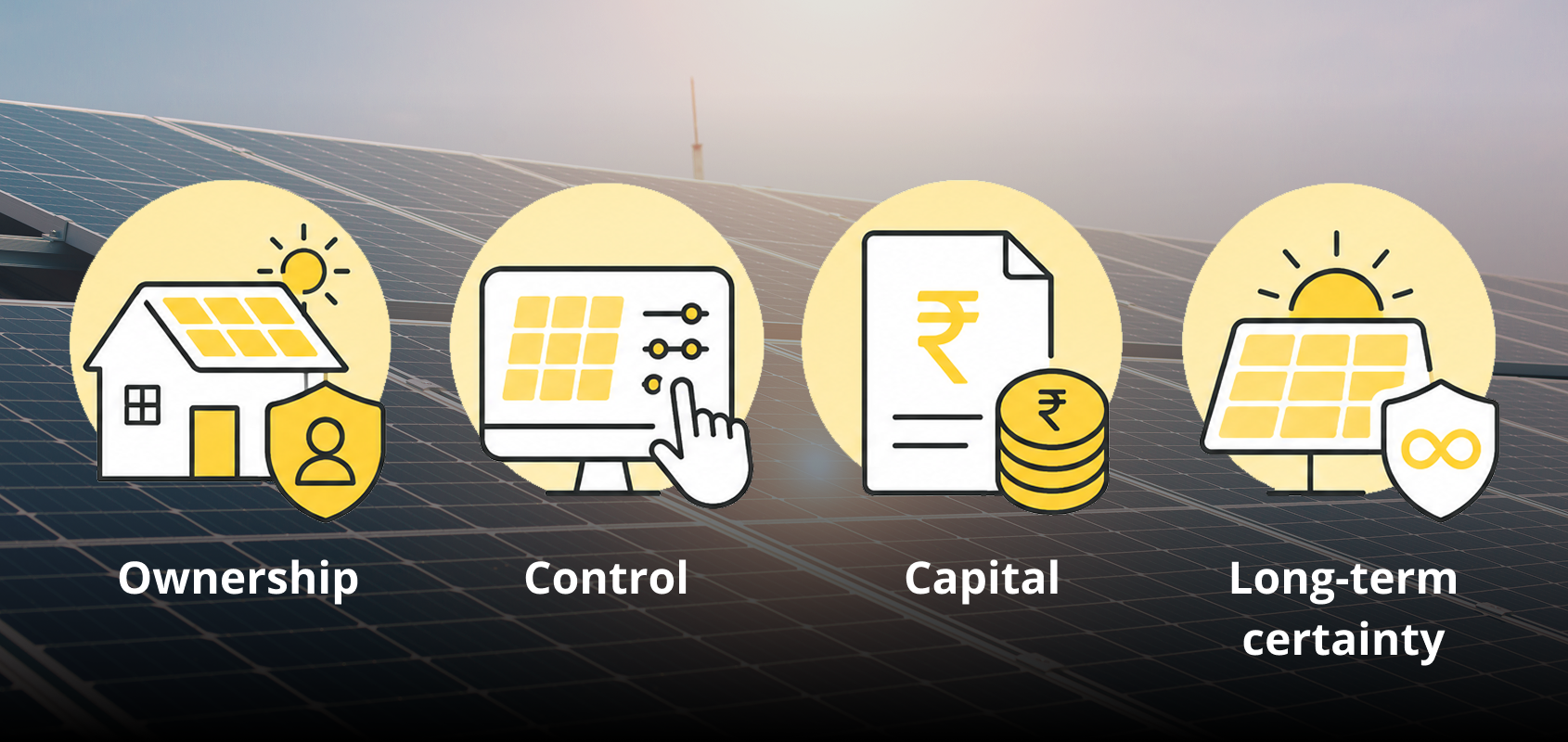
For businesses, solar is no longer just a cleaner way to power operations. It is becoming a strategic call on ownership, capital, control, and long-term certainty. That is why the group captive solar model is drawing sharper attention, especially after the Electricity (Amendment) Rules, 2026 clarified captive power provisions and simplified rules for group captive arrangements.
The shift is important because every solar route changes the business equation differently. CAPEX gives ownership; OPEX offers lower upfront commitment, and group captive sits between the two with shared responsibility and scale. Understanding where each model stands can help businesses choose solar with greater confidence, not just greater intent.
What sets the group captive solar model apart?
For businesses planning a long-term shift to solar, choosing the best solar procurement model is less about a single tariff and more about striking the right balance among investment, control, risk, compliance, and scalability.
| Decision point | Group captive solar | CAPEX solar | OPEX solar |
|---|---|---|---|
| What the model really means | Multiple consumers invest in a shared project or SPV (Special Purpose Vehicle) and draw power via open access | The business buys, owns, and uses the solar asset | A developer owns the asset and sells power to the business through a Power purchase agreement |
| Capital requirement | Moderate, since consumers contribute equity but do not fund the full project alone. | Highest at the start, since the business funds the project. | Lowest upfront, since the developer carries the asset investment |
| Ownership structure | Shared ownership, subject to captive requirements such as collective equity and annual consumption thresholds | Complete asset ownership sits with the consumer | Ownership stays with the third-party developer |
| Tariff advantage | Savings can be stronger because captive open access may reduce key surcharge exposure, subject to applicable state rules. | Savings improve over time once the asset starts delivering returns | Savings depend on the contracted PPA tariff versus grid power |
| Control | Better strategic control than OPEX, without the burden of owning the complete asset. | Highest control over asset, vendor, performance, and maintenance choices | Limited control, with most terms defined by contract |
| Operations and maintenance | Usually handled by the developer or SPV (Special purpose vehicle), with defined service standards | Managed by the consumer or an appointed O&M partner. | Managed by the developer as part of the service arrangement |
| Risk profile | Risk is shared between participants and the developer, with compliance needing careful monitoring | The consumer carries performance, maintenance, and asset risk. | Most project and performance risk sits with the developer. |
| Scalability | Strong fit for large commercial and industrial energy demands spread across multiple locations | Works best where capital, roof space, or land are available | Easier to start across suitable sites with limited investment |
| Renewable energy scale | Strong fit for larger renewable energy procurement, especially for businesses with high or multi-location power demand | Scale depends on available capital, rooftop space, or land owned by the business | Easier to scale gradually across suitable sites without major upfront investment |
| Regulatory complexity | Involves open access approvals, captive compliance, and state-specific rules, making regulatory planning important from the start | Usually simpler for rooftop or owned-site projects, depending on net metering, DISCOM approvals, and local rules | Largely managed by the developer, though the consumer must evaluate PPA terms, approvals, and site-level conditions |
| Best fit | Businesses that want large-scale renewable power without full project ownership | Ideal for businesses that want full ownership, have capital available, and seek long-term savings | Businesses that want quick solar adoption without asset ownership |
For businesses, the group captive solar model brings the conversation back to what matters most: reliable renewable power, balanced responsibility, and long-term energy certainty. To understand the foundation behind any solar route, from panels and sizing to installation and maintenance, explore this guide to solar panels in India.
This spin runs on sunshine
From surprising solar facts to smart energy tips, every spin uncovers a side of the sun you may not have seen before
Bottomline
The solar model a business chooses can quietly shape its energy economics for decades. CAPEX rewards those ready to own the asset, while OPEX makes adoption easier by removing the capital burden. For many commercial and industrial consumers, the group captive solar model offers a powerful middle path, combining shared ownership, long-term cost visibility, and large-scale renewable energy procurement. That is the real takeaway: solar adoption is easy to announce, but the smartest businesses will win by choosing the structure that protects cost, control, and certainty together.

Turn sunlight into smarter power for your business
Explore Tata Power’s solar solutions for savings, scale and cleaner energy
Frequently asked questions
The frequently asked questions section is a reliable source for unlocking answers to some of the most crucial inquiries. Please refer to this section for any queries you may have.
- FAQ
The group captive solar model allows multiple electricity consumers to jointly participate in one solar project and use the power for captive consumption.
It usually includes -
- Shared ownership by participating consumers
- Minimum 26% collective ownership in the project
- Minimum 51% collective consumption of generated power in a financial year
- Renewable power procurement without full project ownership or full capital investment
Before signing a group captive solar PPA, businesses should review more than the quoted tariff. Important checks include -
- Project ownership structure
- Captive compliance responsibility
- Open access charges
- Contract tenure and exit terms
- Generation estimate and energy settlement
- State-level banking and wheeling rules
A well-reviewed agreement helps ensure the group captive solar model remains financially attractive, compliant, and operationally practical over the contract period.
Yes, group captive solar can support corporate sustainability goals by helping businesses procure renewable electricity at scale. Since power is linked to a solar generation project, it can contribute to renewable energy procurement and decarbonization plans, subject to proper energy accounting and documentation. For companies with ESG or net-zero commitments, the model offers a practical route to cleaner power without depending only on rooftop capacity.
Approvals for group captive solar depend on the state, project location, and open access route.
They usually cover -
- Open access application and approval
- Grid connectivity and wheeling arrangement
- Metering, scheduling, and energy accounting
- Captive ownership and consumption compliance
- State-level banking, wheeling, and settlement rules
Before choosing the best solar procurement model, businesses should check approval timelines, consumer responsibilities, and state-specific regulations.
Group captive solar can reduce electricity costs for eligible businesses, but savings depend on more than the quoted tariff.
A strong group captive solar comparison should check -
- PPA tariff against grid tariff
- State open access charges
- Wheeling charges and transmission losses
- Banking and settlement rules
- Project compliance and consumption pattern
The model works best when demand, location, and regulatory conditions align.
Yes, captive generators have the right to open access for carrying electricity to their own use, subject to the conditions and regulations set by the appropriate commission. For group captive solar projects, this means power can be supplied from an off-site solar plant to participating consumers through the grid. However, approvals, charges, metering rules, and timelines may differ across states, so state-level regulations remain critical.
The group captive solar model must meet two core captive conditions in India. Captive users must collectively hold at least 26% ownership in the generating plant and consume at least 51% of the electricity generated during the financial year. These requirements are important because the project must continue to qualify as captive. If the conditions are not met, the expected open access and surcharge-related benefits may be affected.
Sources
1. Captive Power Plant vs Group Captive Power in Open Access Green Energy: A Strategic Guide for Procurement and Operations Leaders
2. What is Group Captive Open Access? Why should businesses opt for Renewable Energy transition through this route?
3. What Are Captive Solar Projects?
4. Regulatory Landscape - Captive Consumption in India
5. Government issues draft revisions to captive power project rules
6. CAPEX vs OPEX solar model: Which one should you pick?
7. CAPTIVE / GROUP CAPTIVE
Keep reading...
View all