


 Contact us
| Parameter | Value |
|---|---|
| Daily generation per 1kW system | 4 to 5 kWh |
| Annual generation per 1kW system | 1,500 to 1,800 kWh |
| Annual common area consumption (GHS) | 30,000 kWh |
| Recommended system size | 20kW |
| Monthly savings (at Rs. 7/unit) | Rs. 17,500 |
| Annual savings | Rs. 2,10,000 |
| Savings over 25 years | Rs. 52,50,000 |


What are the benefits of going solar for housing societies in India?
The benefits of going solar for housing societies include lower electricity bills, reduced carbon emissions, increased property value, improved operational efficiency, and greater long-term energy independence, all enabled through a single rooftop installation. Here is a closer look at what your society actually stands to gain.
13 reasons why residential societies are going solar:
1. Solar energy for residential societies lowers electricity bills
Common areas in a housing society, including lifts, water pumps, corridor lighting, security systems, and clubhouses, consume a large and consistent amount of electricity every single month. Solar directly offsets this consumption, reducing electricity bills from the start.
Not sure of how this works? Here is what that looks like in real numbers for a Group Housing Society:
Figures are illustrative estimates based on an average tariff of Rs. 7/unit and standard generation benchmarks per MNRE guidelines. Actual savings vary based on location, tariff, and system size.
Societies across Mumbai, Pune, Delhi, and Bengaluru report reducing common area electricity bills by 65 to 90% after going solar, with saving lakhs annually.
2. Solar delivers a strong return on investment
Solar is not an expense. It is an investment with measurable, long-term returns, and for most housing societies, the numbers make a clear case.
Here is how this ROI is achieved:
- Short payback period: Most societies recover their installation cost within 4 to 5 years, after which the system generates essentially free electricity for 20 plus more years.
- Net metering credits: Surplus power exported to the grid earns bill credits, further shortening the payback period and improving overall returns.
- Zero-investment options: OPEX models allow societies to pay per unit without upfront cost.
3. Government subsidies reduce the upfront cost significantly
Government subsidies significantly lower the upfront cost of solar for housing societies, with both central and state policies offering targeted support for residential installations.
- Central subsidy via PM Surya Ghar: Muft Bijli Yojana: As per the official PM Surya Ghar portal, “Group Housing Societies and Resident Welfare Associations are eligible for ₹18,000 per kW for common facilities, including EV charging, up to 500 kW capacity.” The scheme has a total outlay of ₹75,021 crore, reflecting the government’s long-term commitment to residential solar.
- State-level incentives: As outlined in the Delhi Solar Energy Policy 2023 , Delhi provides that “residential consumers are eligible for a capital subsidy of ₹2,000 per kW, capped at ₹10,000 per consumer,” along with generation-based incentives for residential and commercial users.
- Virtual net metering: Allows a single rooftop system to distribute bill credits proportionally across individual flat meters and common area connections.
4. Unused rooftop space becomes a productive asset
Most housing society rooftops sit empty year after year, representing an opportunity cost that rarely comes up in committee meetings. Solar changes that conversation entirely. When panels go up, that idle surface starts generating measurable financial returns from day one.
- Parking areas can be fitted with solar carports that generate power while providing shaded cover for vehicles, a dual-use solution that maximizes every available surface.
- A standard 10kW solar system requires roughly 1,000 square feet of shadow-free rooftop space, which most mid-sized societies have to spare. Every square foot commissioned directly impacts the monthly electricity bill.
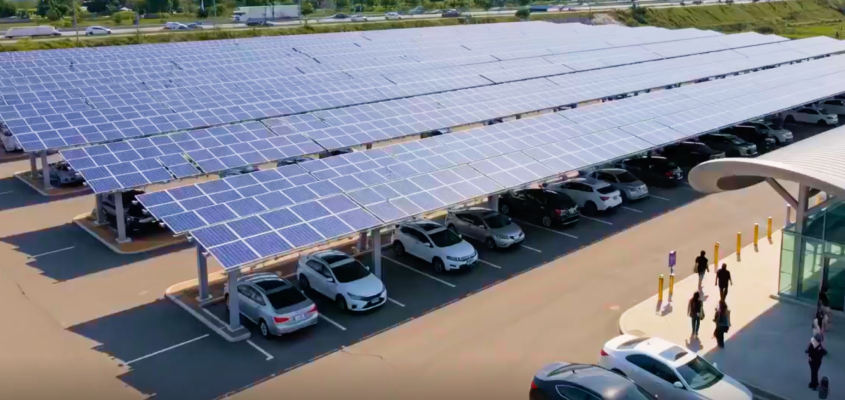
Solar carports show how solar energy for residential societies can turn parking spaces into power-generating, shaded infrastructure
5. Every resident benefits, regardless of floor or flat type
One of the most important benefits of solar for housing societies is that it does not discriminate by floor. Through virtual net metering, the output of a single centrally installed system is distributed proportionally to every participating flat. A resident on the fifth floor with no private terrace receives the same access to solar savings as someone on the top floor with a rooftop garden.
The society handles everything, and the financial benefit flows to every resident on their monthly bill.
6. Solar systems allow housing societies to monitor energy use in real time
Modern solar installations come with monitoring software that gives the committee a live view of generation, consumption, and grid export at any given point:
- Performance tracking: Issues can be identified early, preventing losses.
- Consumption insights: Data across common areas reveals patterns, helping societies make smarter operational decisions.
- Accountability and transparency: When generation and savings data is accessible and visible, it builds resident confidence in the investment and gives the committee a credible, data-backed success story.
7. Solar panels need very little maintenance
Solar panels have no moving parts, and that mechanical simplicity is one of their biggest advantages when it comes to a housing society:
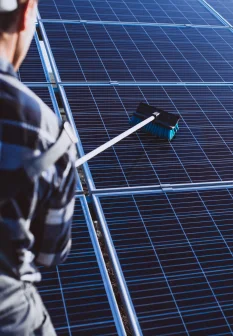
Dust and particulate accumulation is the primary performance concern in Indian cities, and a consistent cleaning schedule addresses it effectively. Periodic cleaning helps panels maintain output levels close to their rated capacity throughout the year.
Periodic cleaning
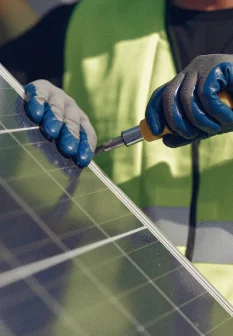
A qualified technician visiting once a year is typically sufficient to keep the system running at peak efficiency and catch any minor issues before they escalate.
Annual inspection
Most reputable installers offer Annual Maintenance Contracts at a predictable fixed cost, which means no surprise expenses and no ambiguity in the society's annual budget
Fixed AMC costs

8. Solar meaningfully reduces a housing society's carbon footprint
Every unit of electricity generated by solar displaces a unit that would otherwise have come from a coal-dependent grid. A single 5kW solar system offsets approximately 6 tons of CO2 annually, and at the scale of a housing society running a 20kW or larger installation, that figure becomes substantial over 25 years.
It is the single most impactful step available, one that reduces the building's dependence on fossil fuels, cuts its contribution to urban air pollution, and aligns it with India's national net-zero target for 2070. It is also a commitment that residents, visitors, and prospective buyers can all see and take note of.
9. Solar eliminates dependence on diesel generator backups
Diesel generators are among the most expensive, noisy, and polluting pieces of infrastructure a housing society manages. Fuel costs are unpredictable, procurement requires active coordination, and every hour of runtime adds to maintenance wear. A solar installation, particularly one paired with battery storage, significantly reduces and in many cases eliminates the need to run a generator during daytime power outages.
- No fuel procurement, no refill coordination, no generator maintenance scheduling.
- Less diesel runtime means less exhaust, less noise, and a noticeably more pleasant common area environment for residents.
10. Solar builds energy independence and shields against tariff volatility
Grid power in India, while improving, remains subject to outages, voltage fluctuations, and tariff revisions that housing societies have no control over. Solar introduces a degree of energy independence that no utility connection can offer.
During peak sunlight hours, a well-sized system meets the society's entire common area demand without drawing a single unit from the grid. Hybrid systems with battery energy storage extend this independence well into the evening, providing a reliable buffer that is not tied to grid availability.
11. Solar increases property values and attracts buyers
Homebuyers today weigh energy costs and sustainability credentials more carefully than before, and a solar-equipped society addresses both in a single visible step. A rooftop installation signals lower maintenance charges, reduced electricity bills, and a management committee that has made a forward-looking decision on behalf of its community.
Properties in solar-equipped societies consistently command a premium at resale and rental, a trend that strengthens as energy costs rise and green building awareness grows.
12. Society-level solar means no hassle for individual residents
At society-level installations, the partner handles end-to-end execution, including design, installation, approvals, and maintenance. Individual residents do not interact with any vendor, government portal, or technical process.
The collective model also means installation costs are shared across the community, making the per-unit economics considerably more favorable than any individual rooftop setup could achieve.
13. Modern solar panels enhance a society's aesthetic appeal
Contemporary solar panels are sleek, low-profile, and increasingly designed to complement modern residential architecture rather than compete with it. Building-integrated photovoltaic options sit flush with rooflines and facades, generating power without visually disrupting the building's character.
Solutions like Solar Designer Spaces by Tata Power take this a step further by combining functionality with design, enabling solar installations that are thoughtfully integrated into terraces, pergolas, and shared spaces, turning rooftops into both energy-generating and visually appealing zones.

Taken together, the benefits of solar for housing societies in India cover every dimension that matters to a residential community: lower costs, stronger finances, greater energy security, a reduced environmental impact, and a more attractive, modern building. No single upgrade delivers this breadth of returns. And because the system serves the entire community from a single rooftop installation, the value compounds across every flat, every resident, and every year of the system's 25-year life.
From high tariffs to 40% savings: A society’s solar transformation with Tata Power
For most housing society committees, going solar is about finding a partner who has done this before, at scale, with real results.
Consider what happened at Vivarea Condominium, a large residential complex in South Mumbai.
What Vivarea needed: A meaningful, lasting reduction in electricity costs that every resident would actually feel on their bill, not just a marginal improvement in common area expenses.
The challenge: The scale of what they needed did not fit the conventional rooftop solar model. They needed something structured differently.
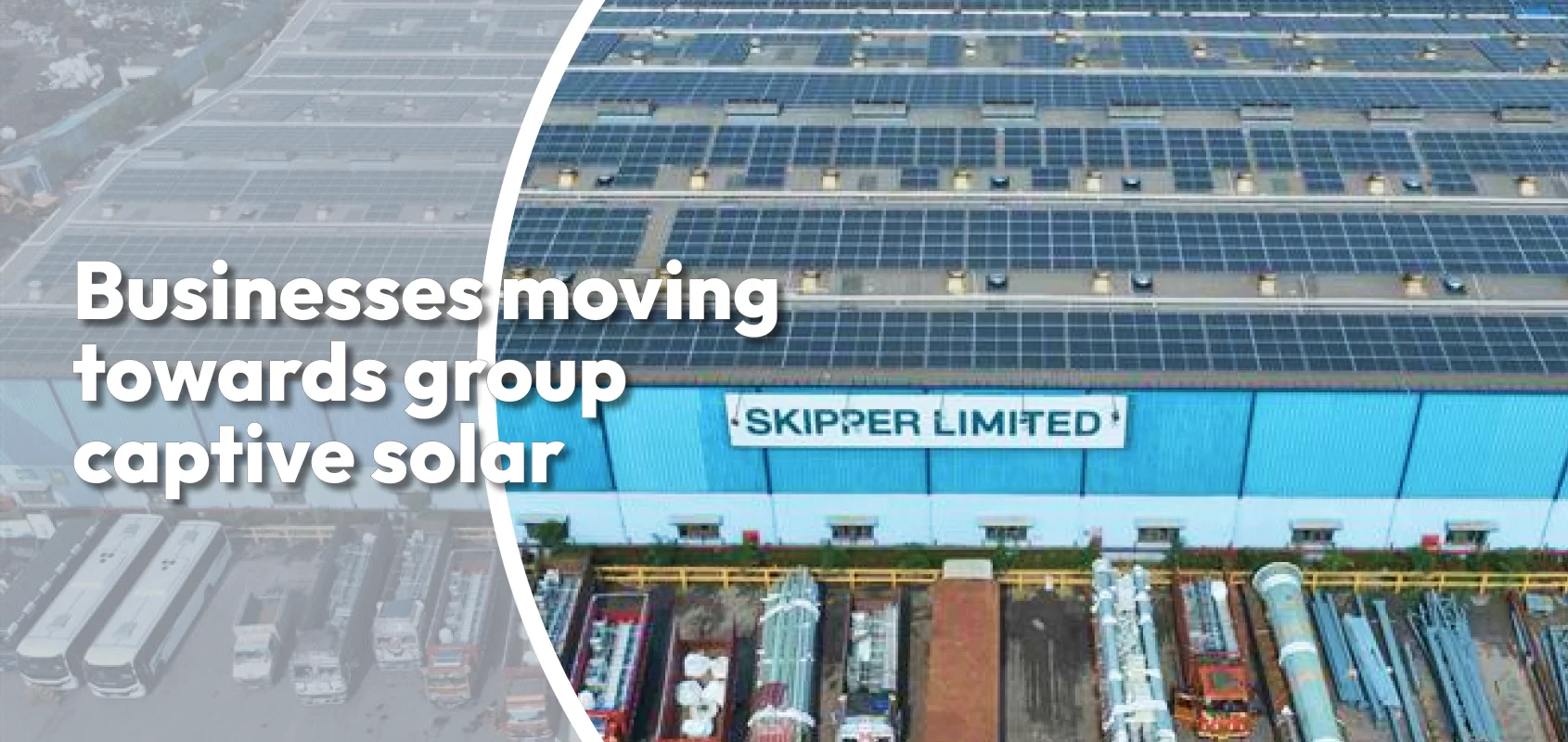
The solution: In January 2023, Tata Power Renewable Energy Limited set up a group captive solar plant and the results set a new benchmark:
- A 3.125 MW plant, fully designed, built, and maintained by Tata Power Renewable Energy Limited.
- Generates approximately 7.5 million units of energy annually, powering the society's domestic and common area needs.
- Delivers ~40% lower electricity costs compared to grid tariffs.
- Offset 6.15 metric tons of CO2 in its first year alone.
- Made Vivarea the first residential society in India to access captive solar energy for domestic usage.
Something the industry had long theorized but never proven at this scale was now a reality: a housing society powering itself on clean energy.
In the words of Mitesh Mehta, Honorary President of Vivarea Condominium: "We will be the first in the country to get green power at roughly 40% less than the cost of the existing tariff. We believe that investment in green energy is investment in the future of mankind."
Eager to learn more about Tata Power’s impact on the condominium? Here’s the full story. Read now!
Vivarea is one example. Across India, Tata Power Solaroof has been the country's number one rooftop solar company for eight consecutive years, with a presence in 300 plus districts and a growing track record with housing societies of every size and configuration. For committees looking to make the same move, here is what the partnership looks like in practice:
- End-to-end ownership: Site survey, system design, installation, net metering, subsidy processing, and long-term maintenance are all handled centrally. The committee manages one relationship, not several.
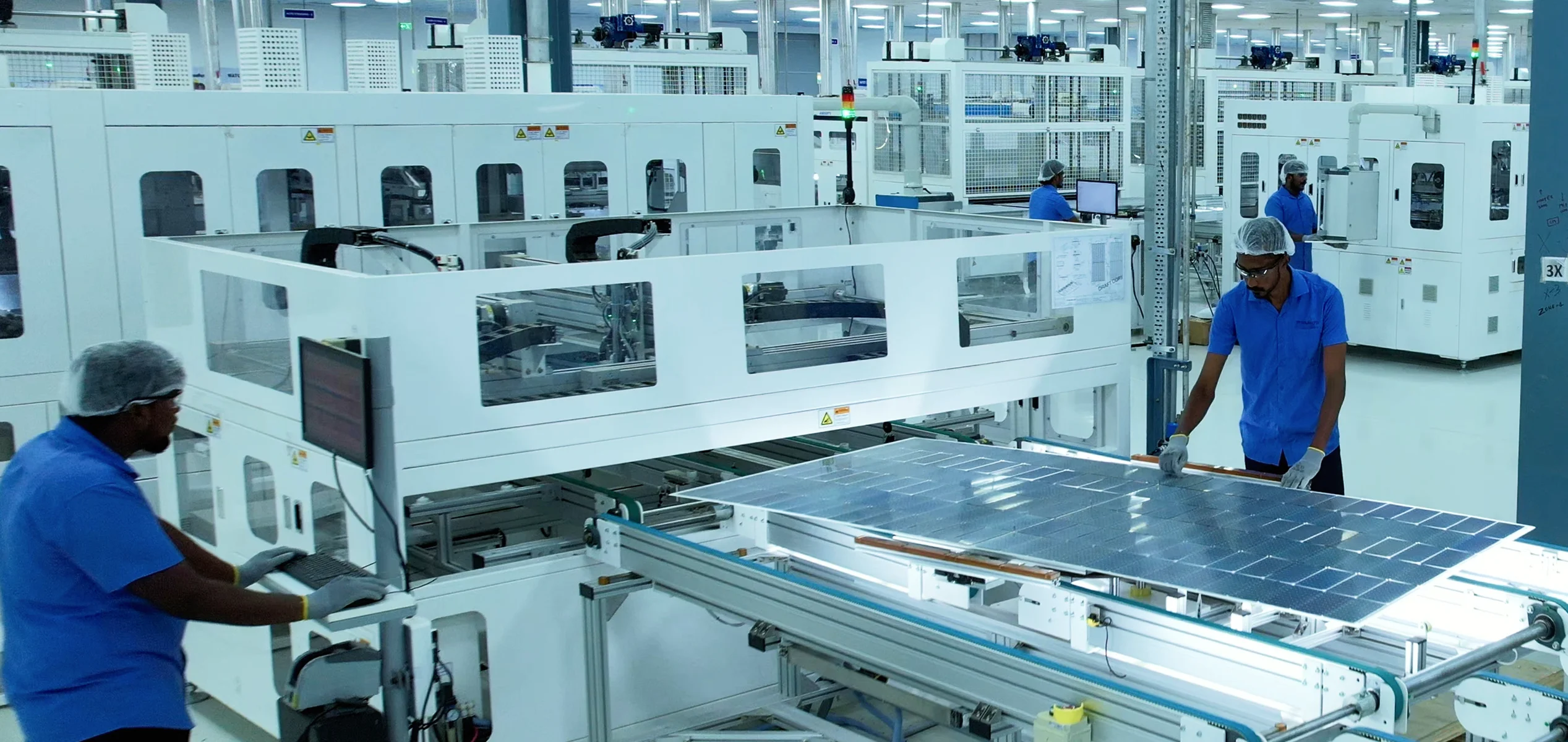
- In-house manufactured panels: Tata Power's ALMM-approved modules are manufactured at its own facility and carry a 25-year performance warranty, so accountability for panel quality rests with the same company that installs and services the system.
- Flexible financing: EMI options through 20 plus banks and NBFCs mean societies can go solar without drawing on the corpus fund.
- Subsidy and compliance support: From PM Surya Ghar applications to state-level incentives and net metering registrations, Tata Power ensures no eligible benefit goes unclaimed.
Every month your society stays on grid power is a month of savings, subsidies, and energy independence left on the table. The sooner the conversation starts, the sooner the numbers start working in your favour. The time for the switch is here, and the time is now!

Is solar energy worth the switch?
Here is everything you need to know about the multi-fold impact of this superpower
Bottomline
Solar energy is no longer a forward-thinking experiment for housing societies in India. It is a proven, financially sound decision, and the window to act has never been more favorable. Tariffs are rising, subsidies are live, and the technology has matured to the point where the barriers to adoption are lower than they have ever been. The benefits, from lower bills and energy independence to stronger property values and a reduced carbon footprint, are wide-ranging and compound quietly over the system's 25-year life. All it takes is the right installation, the right partner, and a committee willing to make the call. With Tata Power Solaroof's end-to-end support and a track record built across hundreds of societies nationwide, that first step is a lot more straightforward than most committees expect.
Frequently asked questions
The frequently asked questions section is a reliable source for unlocking answers to some of the most crucial inquiries. Please refer to this section for any queries you may have.
- FAQ
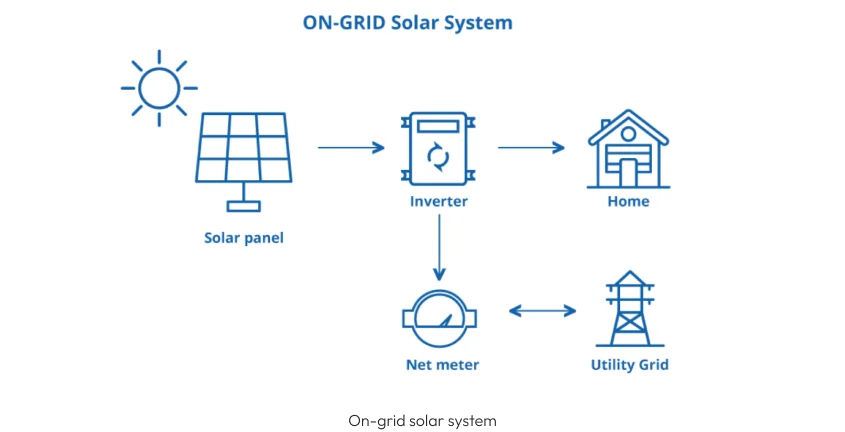
Solar energy for residential societies works by generating electricity through rooftop solar panels that power common areas. The system converts sunlight into electricity, which is used for lifts, lighting, water pumps, and other shared facilities, with excess power either fed back into the grid or offset through net metering.
Yes, solar power is cost-effective for housing societies as it significantly reduces monthly electricity expenses. Over time, the savings on common area bills outweigh the initial investment, especially when combined with subsidies and rising grid tariffs. To understand the exact savings potential for your society, start with a free consultation with Tata Power. Call now!
Yes, housing societies in India can access government subsidies for solar installations. Schemes like the PM Surya Ghar initiative offer financial support for common facilities, making adoption more affordable and improving overall project viability.
The typical payback period for solar in housing societies ranges from 3 to 5 years. This depends on system size, electricity tariffs, subsidy benefits, and consumption patterns, after which the electricity generated is essentially free.
Rooftop space requirements depend on the system size, but on average, 1 kW of solar needs about 80–100 square feet. Societies can scale installations based on available terrace space and energy needs.
Yes, solar power can run most or all common facilities in a society, depending on system capacity. Properly sized systems can support lifts, lighting, water pumps, and even EV charging infrastructure, reducing reliance on grid electricity.
Solar systems require minimal maintenance, mainly regular panel cleaning and periodic system checks. With proper monitoring and annual maintenance contracts, systems can operate efficiently for 25 years or more.
Solar is suitable for most types of residential societies, including apartments, gated communities, and villas. Feasibility depends on rooftop availability, shadow-free space, and energy consumption patterns, but most societies can benefit from some level of installation.
Sources
1. Solar for Housing Society: Subsidy, Benefits and Easy Financing — Ornate Solar
2. Reliable Rooftop Solar for Housing Societies in India — SolarSquare
3. Virtual Net Metering in India: A Simple Guide for Housing Societies 2025 — Infisol Energy
4. Best Solar Panel Options for Societies and Row Houses in India — Solar Earth
5. Solar for Housing Societies in Delhi — Synergy Solar
6. Solar Energy: A Sustainable Solution for Housing Societies — ApnaComplex Blog
7. Advantages of Installing Solar Panels in Dwarka Societies — Dwarka4u News
8. How Housing Societies Can Become 100% Solar-Powered — Visol India
9. PM Surya Ghar: Muft Bijli Yojana — Official Portal — Government of India
10. Central Subsidy — Delhi Solar Portal, Department of Power, GNCT of Delhi
11. About Delhi Solar Energy Policy 2023 — EEREM, Delhi
12. National Solar Rooftop Portal — MNRE, Government of India
Keep reading...
View all