


 Contact us
Flexi EMI scheme makes clean energy the default, not the alternative


Sections
- Introduction
- What is the SunSmart Flexi EMI Scheme?
- How does “Pay As You Save” work under the Flexi Emi Scheme?
- Why is the Flexi Emi Scheme an industry-first move?
- Flexi EMI vs RESCO vs CAPEX: What’s the difference?
- What are the highlights of the Flexi-Emi scheme?
- Who can benefit from the Flexi Emi scheme?
- How is the EMI calculated under the Flexi Emi Scheme?
- What scale does Tata Power Solaroof bring to the Flexi Emi Scheme?
- What does the Flexi Emi Scheme mean for businesses?
- Bottomline
- FAQs
- Sources
Introduction
For many businesses, the decision to go solar is straightforward. The challenge lies in how the investment fits into existing financial plans. High upfront costs and rigid repayment structures often slow down solar energy adoption, even when long-term benefits are clear.
To bridge this gap, Tata Power Renewable Energy Limited, through Tata Power Solaroof, in partnership with Tata Capital, has introduced the SunSmart Flexi EMI Scheme. It simplifies rooftop solar financing by aligning payments with the value generated by the rooftop solar system, making the transition to clean energy more practical and financially manageable for businesses.
What is the SunSmart Flexi EMI Scheme?
The SunSmart Flexi EMI scheme is an innovative solar financing solution for C&I customers. It is designed to make rooftop solar easier to adopt by reducing the usual upfront pressure that businesses face when they evaluate clean energy projects. The Flexi EMI scheme is built for flexibility, accessibility, and smoother decision-making, enabling faster adoption and long-term operational savings.
How does “Pay As You Save” work under the Flexi Emi Scheme?
The “Pay As You Save” model aligns customer repayments with estimated solar energy generation. In simple terms, the repayment structure is designed so that C&I customers can pay through the value created by the solar system, rather than treating the EMI as an unrelated fixed burden.
The scheme offers -
- Monthly EMIs or lease rentals linked to projected power output
- Repayment aligned with estimated solar generation
- A structure that helps businesses optimize cash flows while transitioning to clean energy
This is what makes the model feel different from standard solar financing. It is not only about borrowing, but about matching repayment with expected solar energy generation.
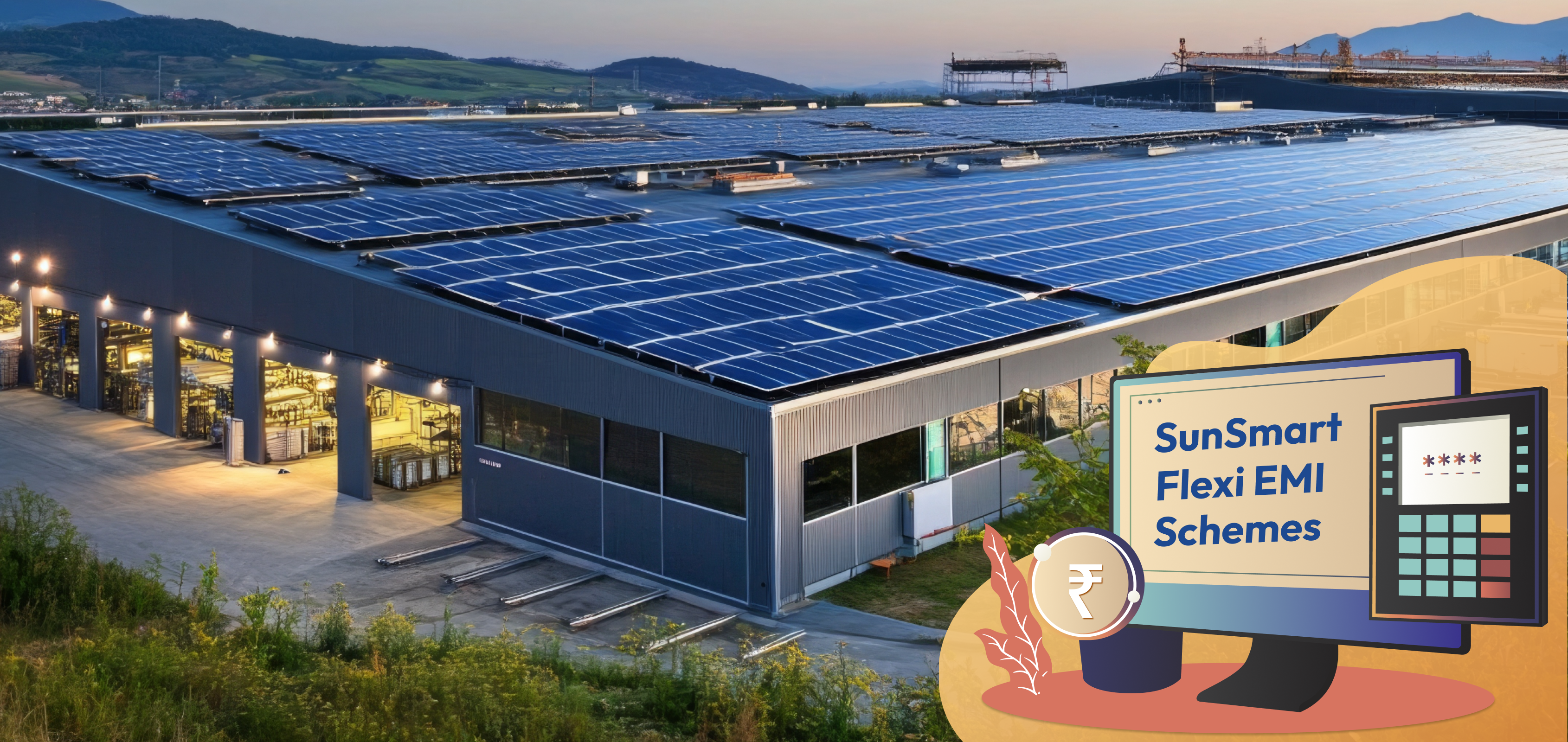
Why is the Flexi Emi Scheme an industry-first move?
This is positioned as an industry-first move in rooftop solar financing for C&I customers because -
- Repayment is tied to solar generation estimates
- Financing is aligned with asset performance instead of fixed schedules
- Businesses get better predictability in financial planning
It also reduces the mental friction that often comes with infrastructure decisions. When repayment is linked to projected output, the financing conversation becomes simpler, clearer, and more aligned with the way businesses think about operating costs and savings.
Flexi EMI vs RESCO vs CAPEX: What’s the difference?
Businesses typically evaluate rooftop solar through different financing models. Here’s how the Flexi EMI model compares with traditional approaches.
| Parameters | Flexi EMI model | RESCO model | CAPEX model |
|---|---|---|---|
| Upfront investment | Low upfront or financed | No upfront cost | High upfront cost |
| Ownership | Ownership with financing | No ownership | Full ownership |
| Payment structure | EMI linked to solar generation | Pay per unit of power consumed | One-time capital expense |
| Cash flow impact | Structured payments aligned with savings | Operational expense over time | Immediate capital outflow |
| Savings potential | Balanced savings with manageable payments | Moderate savings over the contract period | Highest long-term savings |
| Financial flexibility | High | Medium | Low |
| Decision complexity | Lower due to an aligned repayment structure | Medium due to long-term contracts | High due to capex commitment |
What are the highlights of the Flexi-Emi scheme?
The Flexi Emi Scheme brings together the financing features businesses usually look for in one place -
- Collateral-free financing
- Competitive interest rates
- Flexible repayment terms
- Seamless digital processing
Key financial details include

Loan amount:
₹10 lakh to ₹500 lakh

Loan-to-value:
Up to 85%

Interest rate:
Starting from 10.5% (Reducing)

Tenure:
Up to 7 years

Collateral:
Nil

Processing fee:
0.25% to 0.5%

Approval:
Instant digital approval with minimal docs
These numbers matter because they show that the scheme is not only about access to solar, but also about making financing usable for real business conditions.
Who can benefit from the Flexi Emi scheme?
The scheme is designed to serve a wide range of C&I segments, including -
- Automobile
- Textile
- IT
- Steel
- HVAC
- Cold storage
- FMCG
- Quick commerce
A solar financing model only becomes truly useful when it works across sectors, not just for a narrow set of customers. By catering to multiple industries, the scheme widens the adoption base for rooftop solar.
How is the EMI calculated under the Flexi EMI Scheme?
The Flexi EMI is calculated using PV system generation estimates based on historical solar irradiation data. This means -
- Repayment is linked to expected solar energy generation
- The structure is data-backed and not arbitrary
- Businesses get a clearer framework to evaluate savings
Actual solar energy generation may vary due to factors such as weather conditions, location, and system performance. Businesses should view the EMI structure as generation-linked and savings-led, while still accounting for these variations.
To better understand what drives these variations and how solar performance is measured, explore how solar panels actually work. Learn more
What scale does Tata Power Solaroof bring to the Flexi Emi Scheme?
Tata Power Solaroof brings significant scale and execution experience to the Flexi EMI Scheme
- Around 6,700 installations completed in the current financial year
- More than 580 MWp cumulative capacity in C&I
- Over 3.7 lakh installations across residential and C&I
- More than 4.5 GWp total installed capacity
That scale matters because financing schemes work best when paired with operational credibility. Businesses are not only evaluating the product; they are also evaluating the partner behind it. A large installed base helps reinforce confidence in the promise of rooftop solar.
What does the Flexi Emi Scheme mean for businesses?
For businesses, the biggest value of the scheme is clarity. It gives them a way to adopt rooftop solar with financing that is linked to solar performance, not just borrowing capacity. That makes the move to clean energy feel more manageable and more commercially grounded. It also supports -
- Long-term cost savings
- Improved energy resilience
- Contribution to India’s clean energy transition and Net Zero ambition by 2070
Scratch. Reveal. Learn
Curiosity has its rewards
Bottomline
The SunSmart Flexi EMI Scheme signals a deeper shift in how solar is positioned for businesses in India. It moves the conversation from affordability to alignment, where financing is no longer a barrier, but an enabler tied directly to performance. By integrating energy generation with repayment logic, Tata Power Solaroof and Tata Capital are simplifying decision-making for the C&I sector. This approach reduces hesitation, improves financial visibility, and accelerates adoption across industries with varying energy needs. As rooftop solar continues to scale, such models will play a defining role in turning clean energy from an option into an operational default for forward-looking businesses.

Frequently asked questions
The frequently asked questions section is a reliable source for unlocking answers to some of the most crucial inquiries. Please refer to this section for any queries you may have.
- FAQ
In a CAPEX model, businesses invest upfront and own the system, while in RESCO, a third party owns and operates it with periodic payments. This model sits between the two, offering ownership benefits without a high upfront cost. It combines structured financing with performance-linked repayment, making it more flexible for businesses that want control over assets but prefer staggered financial commitments.
The Flexi EMI structure is designed to align repayments with projected solar generation, which naturally links it to operational savings. This makes it more adaptable compared to fixed EMI models, as the repayment logic is tied to energy output rather than rigid schedules. Such flexibility helps businesses manage seasonal demand variations and maintain financial stability while transitioning to solar.
Yes, the SunSmart Flexi EMI scheme is particularly relevant for businesses with variable or seasonal energy consumption. Since repayment is linked to estimated solar generation rather than fixed obligations, it allows businesses to better align energy savings with financial outflows. This makes it easier to adopt solar without overcommitting financially, especially in industries where demand fluctuates across cycles.
Performance depends on multiple factors, including rooftop size, shadow-free area, panel orientation, and local solar irradiation levels. Even partial shading can significantly reduce output, making site assessment critical before installation. Typically, a solar system requires uninterrupted sunlight to achieve optimal efficiency, and proper system design ensures consistent energy generation aligned with business requirements.
The primary barrier to solar adoption has traditionally been high upfront investment. Solar financing solutions address this by spreading costs over time, making solar more accessible. When combined with generation-linked repayment structures, financing becomes a key enabler that allows businesses to adopt solar without disrupting cash flow or delaying strategic energy decisions.
Rooftop solar systems are designed for long-term operation and deliver consistent output over many years, with a gradual decline due to module degradation. With Tata Power Solaroof, this reliability is strengthened through 25-year module warranties, high-quality engineering, and nationwide service support, ensuring dependable performance. This makes solar a stable solution that supports predictable cost savings and reduces exposure to rising electricity tariffs over time.
Yes, rooftop solar improves energy efficiency by generating electricity at the point of consumption. This reduces transmission and distribution losses that occur in centralized power systems. It also allows businesses to better manage daytime energy demand and optimize consumption patterns, especially in operations that rely heavily on continuous or peak-hour electricity usage.
Businesses should evaluate rooftop availability, structural strength, and sunlight exposure before installation. A shadow-free area is essential, as even minor obstructions can reduce generation efficiency. Additionally, alignment with existing energy consumption patterns is important to ensure that the system is sized correctly and delivers optimal financial and operational outcomes.
Sources
1. Physical Achievements - Installed RE Capacity
2. 2025 Marks Highest-Ever Renewable Energy Expansion in India’s Energy Transition Journey
3. Tata Power Renewable Energy, Tata Capital launch flexible financing scheme for rooftop solar
4. Tata Power Renewables Collaborates with Tata Capital to Unveil First of its kind SunSmart Flexi EMI Scheme - ‘Pay As you Save’ for Commercial & Industrial Customers
Keep reading...
View all