


 Contact us
When you evaluate rooftop solar vs grid power, the difference is not just technical; it is economic. Based on industry estimates and government-aligned benchmarks, the comparison below breaks down how rooftop solar and grid power perform across cost, control, and long-term value.


How does rooftop solar vs grid power compare across key factors?
| Parameters | Rooftop solar | Grid power |
|---|---|---|
| How do they work? | Solar panels capture sunlight, convert it into electricity; an inverter makes it usable, powering buildings, with excess sent to the grid or stored. | Electricity is generated at power plants, transmitted through high-voltage lines, stepped down at substations, and distributed to businesses via the grid |
| Cost per unit | ~₹2.5–₹4 per kWh (lifetime average cost over ~25 years; derived from system cost and generation benchmarks, not fixed by govt) | ₹6–₹15 per kWh depending on state and consumer category; tariffs determined by State Electricity Regulatory Commissions |
| Upfront cost | ~₹45,000–₹65,000 per kW (aligned with MNRE benchmark ranges and market installations) | No upfront cost; infrastructure investment handled by DISCOM |
| Payback period | Typically, ~3–5 years depending on tariff offset, usage, and subsidy (case-dependent; not a fixed government metric) | Not applicable; ongoing operational expense with no capital recovery |
| Lifespan | ~25 years expected system life (as reflected in MNRE rooftop calculator benchmarks) | Not applicable; service-based supply model |
| Tariff trend | Largely fixed post-installation; shields users from future tariff revisions | Variable; periodically revised by regulators based on the cost of supply and policy decisions |
| Subsidies | Up to ₹78,000 under PM Surya Ghar Muft Bijli Yojana (₹30,000 for 1 kW, ₹60,000 for 2 kW, ₹78,000 for ≥3 kW) | No direct subsidy for commercial users; subsidies are primarily directed to residential and agricultural segments via state mechanisms |
| Net metering | Available under DISCOM policies; surplus power exported to the grid with billing credits/adjustments | Not applicable (applies only to grid-connected rooftop solar systems with generation capability) |
| Maintenance cost | Low; limited to cleaning and periodic inverter replacement | Costs bundled within regulated tariffs covering generation, transmission, and distribution; no separate maintenance billing |
| Energy control | High; on-site generation reduces dependence on external supply and pricing | Limited; pricing, supply conditions, and revisions controlled by DISCOMs and regulators |
Rooftop solar offers long-term cost stability and control, while grid power remains flexible but exposes businesses to rising tariffs and external pricing uncertainties.
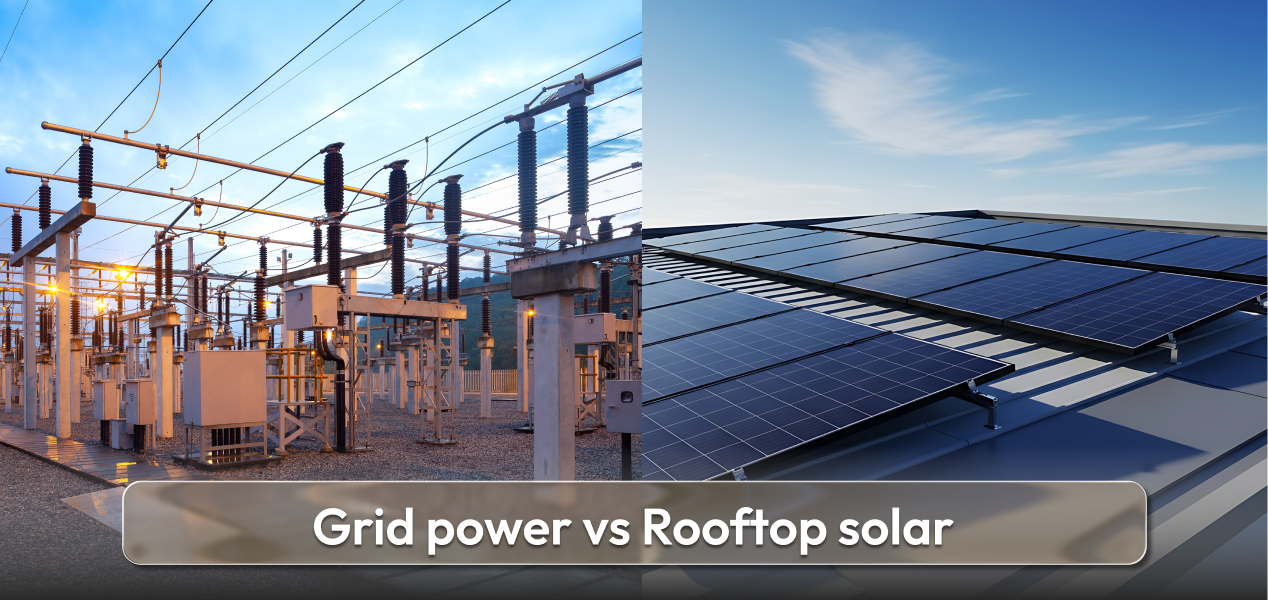
Rooftop solar vs grid power: Rethinking how electricity is sourced
How is Tata Power enabling a more deliberate move to rooftop solar?
For most businesses, the shift from grid dependency to solar adoption does not begin with installation. It begins with clarity.
This is where solutions like Tata Power Solaroof come into the picture. As one of India’s most established rooftop solar providers with over 30 years of experience and more than 1,900 MW of rooftop installations, Tata Power operates across the entire solar value chain, from manufacturing modules to designing and executing customized rooftop systems.
What makes this relevant in the context of rooftop solar vs grid power is not just capability, but how the transition is structured –
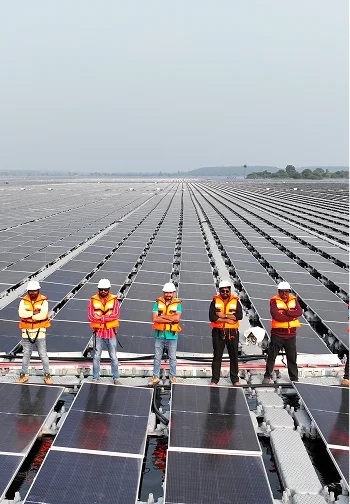
From site assessment and system design to installation and commissioning, the process is managed as a single integrated solution rather than fragmented vendors
End-to-end execution
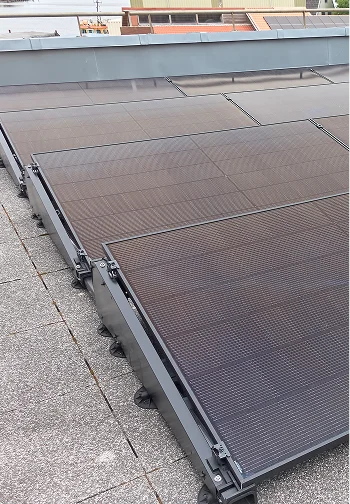
Every rooftop system is tailored to actual consumption patterns, roof conditions, and regulatory frameworks to ensure long-term performance and financial viability
Customized system design
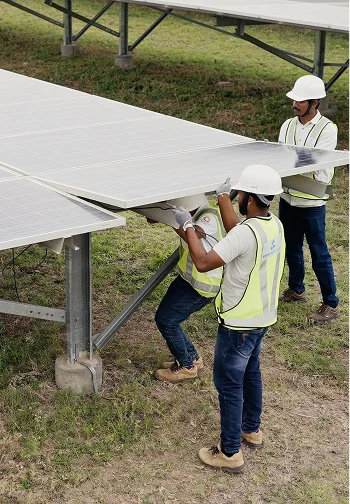
Solar is not a one-time setup. Tata Power’s maintenance programs include monitoring, preventive servicing, and performance optimization, with systems delivering over 99.6% uptime across portfolios.
Operations and maintenance support
Through partnerships like the SIDBI 4E scheme, Tata Power enables MSMEs to access structured financing, making solar adoption viable without heavy upfront strain
Financing enablement for businesses

The scale of execution reinforces this further, with large projects such as the RSSB-EES rooftop solar installation demonstrating how industrial-scale adoption is already underway.
This shift is also being actively driven at a national level. Under initiatives like the Ghar Ghar Solar, the focus is to make rooftop solar more accessible and financially viable across segments. As Dr. Praveer Sinha, CEO & MD of Tata Power, noted while speaking on the initiative - “The initiative will turn solar adoption from an aspiration into an economically viable option.”
The real shift is not just in energy adoption, but in how solar is enabling businesses to take control of costs, risks, and long-term energy decisions, a shift that becomes clearer when you look at it closely.
Power Your Knowledge
Choose correct statement
Bottomline
Electricity in India has come a long way, with supply gaps shrinking to just 0.1 percent, making power more reliable than ever. What has not evolved at the same pace is how businesses manage the cost of that power. The real lens for rooftop solar vs grid power is not cost alone, but control over how that cost behaves. One keeps you plugged into a system you cannot influence. The other lets you shape a part of it. As businesses grow more intentional about long-term planning, the opportunity is not just to consume power better, but to understand it differently.
Frequently asked questions
The frequently asked questions section is a reliable source for unlocking answers to some of the most crucial inquiries. Please refer to this section for any queries you may have.
- FAQ
Grid power is the electricity supplied through a central network managed by DISCOMs. Power is generated at large plants, transmitted over high-voltage lines, and then distributed to consumers. Once connected, you draw electricity on demand without worrying about generation or storage. This system is designed for reliability and scale, which is why it remains the backbone of India’s power supply.
Yes, rooftop solar is generally cheaper than grid electricity in India over the long term. Government programmes by the Ministry of New and Renewable Energy provide subsidies of up to 40% for residential systems, significantly lowering upfront costs. With typical payback periods of about 4–6 years and system lifespans of ~25 years, most electricity generated after recovery is effectively free, making it more economical than rising grid tariffs in many states.
No, most businesses in India cannot rely only on solar power as a standalone source. Government frameworks under MNRE are designed around grid-connected systems, not fully off-grid setups, because solar generation is intermittent and limited to daytime. Official assessments also highlight grid stress and the need for storage as solar capacity rises, reinforcing that backup from the grid or batteries is essential. In practice, businesses use hybrid models combining solar, grid, and storage for reliability.
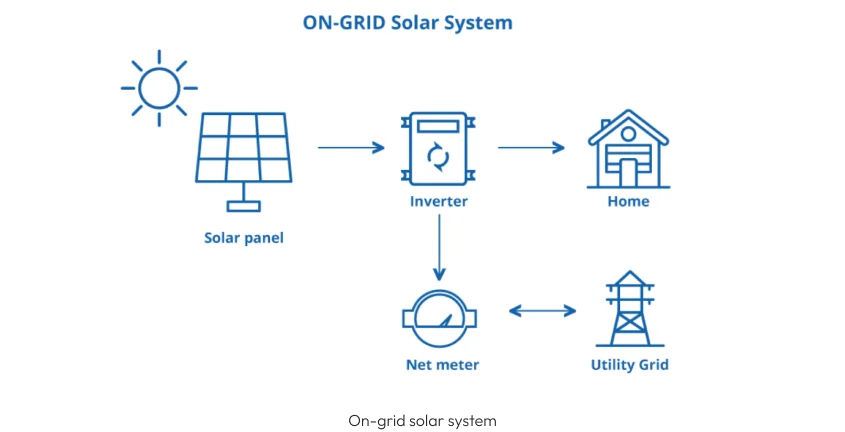
Rooftop solar is not just a power source; it is a small, decentralized energy system built on your own roof. Solar panels capture sunlight and convert it into electricity using photovoltaic cells. That electricity is first used on your premises. If there is a surplus, it flows back into the grid, and when your system is not generating enough, the grid fills the gap.
Not entirely in most cases. A grid-connected rooftop solar system is designed to work alongside the grid, not fully replace it. Solar generates electricity during the day, and any shortfall is automatically supplied by the grid. This hybrid setup ensures reliability while reducing overall consumption from the grid. According to MNRE frameworks, solar is meant to complement existing supply rather than act as a standalone replacement.
Electricity tariffs in India are revised periodically by state regulators based on factors like fuel cost, infrastructure upgrades, and policy decisions. These revisions are not uniform and can vary significantly across states. Since these costs are externally controlled, businesses typically have limited influence over how tariffs evolve, which is why long-term cost predictability becomes an important consideration in energy planning.
As a general benchmark, a 1 kW rooftop solar system requires about 10 to 12 square meters of shadow-free space. This estimate comes from MNRE-aligned guidelines and can vary slightly depending on panel efficiency and installation design. For businesses with larger rooftops, this makes scaling solar capacity relatively straightforward, provided structural and regulatory conditions are met.
Yes, most businesses do not need to disconnect from the grid. Instead, they reduce dependence by supplementing grid power with alternatives like rooftop solar or open access procurement. This allows them to use the grid as a backup while optimizing part of their energy consumption. It is a more practical approach since the grid still ensures reliability during non-generation hours.
DISCOMs are central to how rooftop solar functions in India. They approve grid connectivity, enable net metering, and manage billing adjustments. Without DISCOM participation, a rooftop system cannot interact with the grid. State policies and regulatory approvals determine how smoothly this process works, which is why the experience can vary slightly depending on the location.
Yes, but only under specific frameworks like net metering or net billing, depending on the state. Businesses can export surplus electricity to the grid and receive credits or compensation as per DISCOM regulations. However, the rates and mechanisms differ across states, and in some cases, compensation is lower than retail tariffs, making system sizing an important consideration.
Net metering is what makes rooftop solar practical for most users. When your system generates more electricity than you need, the extra power is sent back to the grid. A bidirectional meter tracks both what you use and what you export. At the end of the billing cycle, you only pay for the “net” units consumed. This mechanism is widely supported under DISCOM policies and helps reduce overall electricity bills.
The payback period depends on a mix of factors rather than a fixed timeline. Your electricity tariff, system size, daily consumption, and whether you receive any subsidy, all play a role. In India, most well-sized systems recover their cost in about 3 to 5 years. After that, the electricity generated is almost free, apart from minor maintenance costs, which is why solar is often seen as a long-term cost hedge.
Under schemes like PM Surya Ghar Yojana, subsidies are primarily aimed at residential consumers with a valid electricity connection and sufficient rooftop space. The system must be installed through a vendor approved by the local DISCOM to qualify. The subsidy amount depends on system size and is credited directly after installation and inspection. Commercial users generally do not receive this subsidy, but can still benefit from long-term savings.
Sources
1. Electricity Rate per Unit in India: List of State-Wise Domestic and Commercial Electricity Rates in 2026
2. Economic survey 2025-26
3. Net metering application 101: Understanding your solar system’s energy credits
4. Net Metering in Delhi - Consumer Guide
5. Frequently Asked Questions for Grid Connected Solar Rooftop Systems
6. FREQUENTLY ASKED QUESTIONS SOLAR ROOFTOP SYSTEM (Ministry of New and Renewable Energy)
7. FAQ: Grid Connected Solar Rooftop System
8. Your guide to understanding On-Grid and Off-Grid solar systems
9. WHICH IS BETTER FOR YOUR HOME OFF-GRID OR ON-GRID SOLAR
10. Rooftop Solar vs. Diesel & Grid
Keep reading...
View all